Summary
E-commerce personalization has moved past simple “customers also bought” widgets. AI now reads behavioral signals, predicts intent, and adjusts recommendations, search results, offers, and content in real time. This shift turns one-time transactions into ongoing relationships. This article breaks down what AI-powered e-commerce personalization actually looks like today, where it’s headed, and how businesses can implement it without wasting budget on the wrong tools.
Introduction
A shopper opens a fashion app, scrolls through running shoes, checks two pairs of leggings, then closes the tab without buying anything. Three days later, she sees an email with the exact shoes she looked at, paired with a matching jacket she never searched for but happens to love. That email wasn’t written by a marketer sitting at a desk guessing what she might want. It was generated by a system that watched her behavior and made a predictio
This is what modern e-commerce personalization looks like. It’s no longer about slotting a “recommended for you” carousel on the homepage and calling it done. AI now studies browsing patterns, purchase history, time spent on product pages, and even hesitation points, then uses that data to shape an experience that feels less like shopping and more like being understood. For businesses trying to compete online, this shift from static recommendations to dynamic, relationship-driven experiences is becoming the difference between a customer who buys once and one who keeps coming back.
Appbirds Technologies works with retail and D2C brands building exactly this kind of AI-driven experience, and the patterns are consistent across industries: personalization that adapts in real time outperforms personalization that doesn’t.
What Is E-commerce Personalization?
E-commerce personalization is the practice of tailoring a shopper’s experience product recommendations, search results, content, pricing, and messaging based on their behavior, preferences, and history. Instead of showing every visitor the same homepage, personalized stores adjust what people see depending on who they are and what they’ve done before.
At its simplest, this might mean showing a returning customer their recently viewed items. At its most advanced, it means predicting what a customer needs before they search for it.
Why Traditional Product Recommendations Are No Longer Enough
Rule-based recommendation widgets were the first wave of e-commerce personalization. “Customers who bought this also bought” logic worked well enough when online shopping was newer and expectations were lower.
That’s changed. Shoppers now compare a retailer’s experience against Amazon, Netflix, and Spotify, all of which use sophisticated AI to anticipate needs. A basic recommendation engine built on static rules can’t keep up with that bar. It doesn’t account for context a customer browsing gifts for someone else looks identical to the system as one shopping for themselves. It doesn’t adjust in real time. And it treats every session as disconnected from the last, missing the bigger picture of who the customer actually is.
The result is recommendation fatigue: customers see the same irrelevant suggestions repeated across every page, and they start tuning them out entirely.
From Recommendations to Relationships: The Role of AI
This is where the shift from recommendations to relationships starts to matter. A recommendation is a single suggestion based on one signal — usually a product view or a past purchase. A relationship is built from many signals over time: what a customer browses, what they ignore, when they shop, how they respond to discounts, and what they’ve bought before.
AI is what makes this possible at scale. Machine learning models can process thousands of behavioral signals per customer and update predictions continuously, something no human marketing team could do manually across a large customer base. Instead of a store reacting to what a customer just did, it starts anticipating what they’re likely to do next.
This is the core idea behind AI-driven e-commerce personalization: less about pushing products, more about understanding people.
How AI Is Reinventing E-commerce Personalization
Understanding Customer Behavior
AI models track how customers interact with a store pages visited, time spent, scroll depth, search terms, cart additions, and abandonment points. Together, these signals build a behavioral profile that goes far beyond purchase history alone.
Predicting Customer Intent
Beyond what customers have already done, AI can estimate what they’re likely to do next. A customer browsing baby products for the first time signals a different intent than a returning parent restocking diapers, and predictive models can tell the difference.
Personalized Product Recommendations
Modern recommendation engines use collaborative filtering, content-based filtering, or a hybrid of both to suggest products that match a shopper’s specific interests, not just general bestsellers.
Real-Time Personalization
Instead of updating recommendations overnight, AI systems adjust in the moment. A shopper’s actions in the current session not just their history directly shape what they see next.
AI-Powered Search
Search bars powered by AI understand intent and context, not just keyword matching. A search for “something for a rainy hike” can return waterproof boots and jackets even without those exact words.
Personalized Offers and Discounts
AI can identify which customers are price-sensitive and which respond better to non-discount incentives like free shipping or early access, avoiding unnecessary margin loss.
Personalized Content and Marketing Campaigns
Homepage banners, email subject lines, and app content can shift based on individual browsing history, making campaigns feel relevant rather than generic.
Dynamic Website Experiences
The homepage a first-time visitor sees can look completely different from what a loyal repeat customer sees, based on predicted intent.
Customer Segmentation and Predictive Analytics
AI groups customers into behavioral segments that update automatically, replacing static demographic segments with ones based on actual purchase signals and predictive analytics in e-commerce.
AI-Powered Customer Journeys
Personalization doesn’t stop after a sale. AI can guide post-purchase journeys from restock reminders to complementary product suggestions that keep the relationship active.
AI Personalization vs Traditional E-commerce Personalization
| Aspect | Traditional Personalization | AI-Powered Personalization |
| Approach | Rule-based, manually configured | Model-based, self-learning |
| Data Used | Purchase history, basic segments | Behavioral, contextual, real-time signals |
| Recommendations | Generic, static | Individualized, dynamic |
| Real-Time Adaptation | Limited or none | Continuous |
| Customer Understanding | Broad segments | Individual-level prediction |
| Scalability | Difficult at scale | Scales across large catalogs and audiences |
| Business Impact | Moderate engagement | Higher conversion and retention potential |
Real-World Examples of AI-Powered Personalization
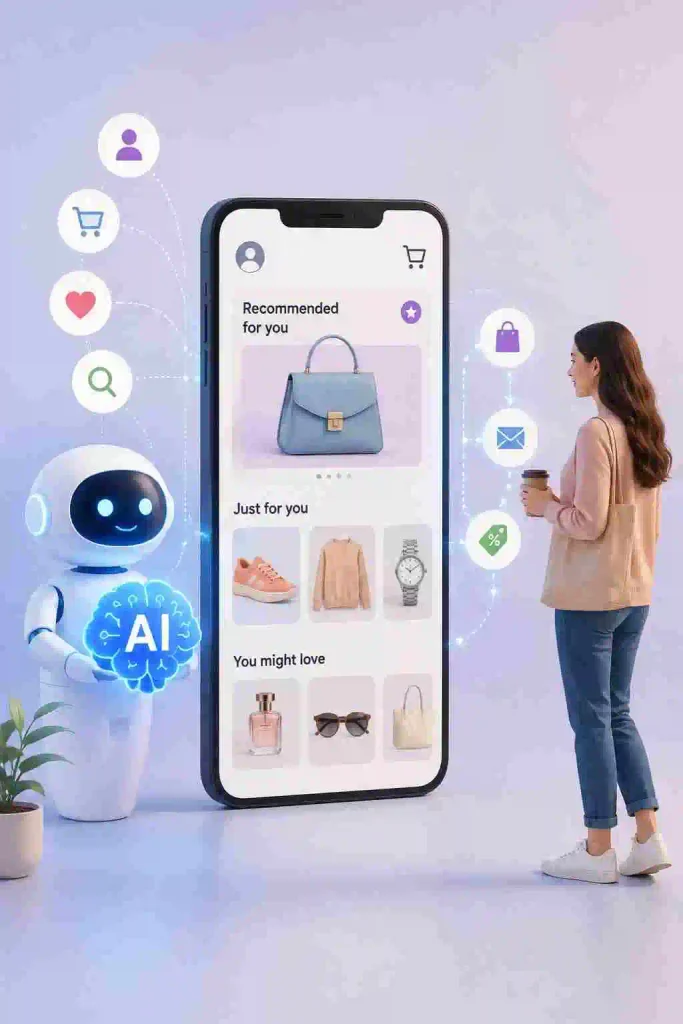
Fashion retail: An online fashion store notices a shopper repeatedly viewing running shoes and sportswear without purchasing. The AI system adjusts her homepage, email content, and search results to prioritize athletic wear, effectively narrowing the gap between browsing and buying.
Electronics: An electronics retailer uses purchase timing data to predict when a customer bought a laptop is likely to need a replacement battery or accessory, triggering a well-timed, relevant offer instead of a generic promotional blast.
Beauty and skincare: A beauty brand uses quiz responses and purchase history together to recommend products suited to a customer’s skin type and past preferences, rather than pushing bestsellers to everyone equally.
General retail: An online retailer changes its homepage layout in real time based on a visitor’s inferred intent showing deal-focused content to price-sensitive browsers and new-arrival content to loyal repeat shoppers.
Benefits of AI-Powered E-commerce Personalization
- Higher customer engagement through relevant content and offers
- Better conversion opportunities by matching intent with the right product at the right time
- Improved customer experience with less irrelevant noise
- Higher average order value through smarter cross-sell and upsell logic
- Stronger customer retention driven by consistent relevance
- More accurate product discovery, especially in large catalogs
- Improved marketing efficiency by targeting the right segments
- Deeper, longer-lasting customer relationships instead of one-off transactions
Challenges of AI-Powered E-commerce Personalization
Despite the upside, AI-powered e-commerce personalization comes with real challenges businesses need to plan for:
- Data quality: AI models are only as good as the data feeding them. Incomplete or inconsistent data leads to poor recommendations.
- Customer privacy: Personalization requires data collection, which means businesses must be transparent about what’s collected and why.
- Data security: Centralizing customer data increases the responsibility to protect it.
- Integration complexity: Connecting AI tools with existing e-commerce platforms, CRMs, and CDPs takes technical planning.
- Over-personalization: Recommendations that feel invasive rather than helpful can damage trust.
- AI bias: Models trained on skewed data can under-serve certain customer groups.
- Implementation costs: Advanced personalization requires investment in tools, data infrastructure, and expertise.
- Maintaining trust: Customers need to feel personalization adds value, not that they’re being watched.
How Businesses Can Implement AI-Powered Personalization
Step 1: Identify personalization goals. Decide whether the priority is conversion, retention, average order value, or all three.
Step 2: Collect and organize customer data. Consolidate behavioral, transactional, and preference data into a usable format.
Step 3: Connect e-commerce systems and data sources. Integrate your storefront, CRM, and marketing tools so data flows in one direction consistently.
Step 4: Choose the right AI or recommendation technology. Match the tool to your catalog size, traffic volume, and technical resources.
Step 5: Start with high-impact use cases. Product recommendations and abandoned cart personalization typically deliver fast, measurable wins.
Step 6: Test and measure results. Use A/B testing to compare AI-driven experiences against existing baselines.
Step 7: Continuously improve personalization models. Treat personalization as an ongoing process, not a one-time setup.
E-commerce Personalization Checklist
- Clear personalization goals defined
- Clean, centralized customer data
- Privacy policy updated and compliant
- Integration plan across storefront and marketing tools
- Chosen AI/recommendation platform matches business size
- High-impact use case identified for launch
- Testing framework in place
- Process for reviewing and refining models regularly
Common Mistakes Businesses Should Avoid
- Personalizing with incomplete or low-quality data
- Recommending products that don’t match actual customer intent
- Ignoring privacy expectations and regulations
- Personalizing too aggressively, which feels intrusive
- Optimizing only for short-term conversions instead of long-term retention
- Skipping testing before rolling out recommendations broadly
- Ignoring customer feedback signals
- Adopting AI tools without a clear business objective
Future of E-commerce Personalization
Several developments are shaping where e-commerce personalization is headed next, though it’s worth separating what’s already usable from what’s still emerging.
Currently available: Real-time personalization, predictive analytics, and AI-powered search are already in production use across mid-size and enterprise retailers.
Emerging and early-stage: Generative AI shopping assistants and conversational commerce are being piloted by major platforms, letting customers describe what they want in natural language instead of navigating filters. Context-aware recommendations that factor in weather, location, or timing are also gaining traction.
Still developing: Fully autonomous agentic commerce, where AI agents complete purchases on a customer’s behalf, and voice-based shopping at scale remain early. These are directional trends worth watching, not capabilities most businesses should build strategy around today.
The common thread across all of these is a move toward hyper-personalized customer journeys that adapt continuously rather than relying on stat
Why Choose Appbirds Technologies
Building AI-powered personalization isn’t just about picking a tool off the shelf. It requires connecting customer data across systems, choosing the right recommendation approach for a specific catalog and audience, and integrating everything into an existing e-commerce platform without disrupting operations.
Appbirds Technologies works with e-commerce businesses on exactly this kind of work custom recommendation engines, AI integration into existing storefronts, customer data integration, and automation that supports personalized digital experiences. Rather than offering a one-size-fits-all plugin, the focus is on building personalization systems suited to a business’s actual catalog size, technical stack, and growth stage, whether that’s a D2C brand just getting started or an enterprise retailer scaling across markets.
FAQs
What is e-commerce personalization?
E-commerce personalization is the practice of customizing a shopper’s online experience including product recommendations, content, search results, and offers based on their behavior, preferences, and purchase history. It aims to make each customer’s experience feel relevant rather than generic, improving both engagement and conversion rates.
How does AI improve e-commerce personalization?
AI improves personalization by analyzing large volumes of behavioral data in real time, something manual rule-based systems can’t do at scale. It identifies patterns in browsing, purchasing, and engagement, then uses those patterns to predict what a customer wants next and adjust recommendations, content, and offers accordingly.
How does AI personalization help e-commerce businesses?
Key benefits include higher customer engagement, improved conversion rates, increased average order value, and stronger customer retention. AI personalization also improves marketing efficiency by targeting the right customers with relevant messaging instead of broad, generic campaigns that often go ignored.
How does AI personalize product recommendations?
AI personalizes product recommendations using techniques like collaborative filtering, which compares behavior across similar customers, and content-based filtering, which matches product attributes to individual preferences. Many systems combine both approaches, refining recommendations continuously as new customer data comes in.
Is AI personalization suitable for small e-commerce businesses?
Yes, though the approach differs from enterprise implementations. Small businesses can start with accessible tools built into e-commerce platforms like Shopify, focusing on high-impact use cases such as product recommendations and cart abandonment emails before scaling into more advanced predictive analytics.
Conclusion
The direction of e-commerce personalization is clear: businesses that treat it as an ongoing, adaptive process outperform those still relying on static, rule-based recommendations. AI makes it possible to understand customers as individuals rather than segments, predict intent before it’s explicitly expressed, and build experiences that keep people coming back rather than just converting them once.
Getting there requires more than installing a recommendation plugin. It takes clean data, the right technology choices, and a willingness to test and refine continuously. Businesses that get this right aren’t just improving conversion rates they’re building the kind of long-term customer relationships that recommendations alone were never designed to create.
If your business is exploring how AI-powered e-commerce personalization could fit into your growth strategy, Appbirds Technologies can help you evaluate the right approach for your platform, catalog, and customer data. Get in touch to discuss your specific requirements.