Summary
Choosing between off-the-shelf AI coding tools and custom-built AI agents depends on your team’s speed requirements, workflow complexity, security needs, and budget. Off-the-shelf tools deliver value in days. Custom agents take longer to build but adapt to your exact engineering workflows. Most fast-growing teams start with off-the-shelf AI coding tools, then move toward custom agents once specific bottlenecks appear.
Introduction
A product manager at a mid-sized retail company recently asked her engineering lead a simple question: “Why does it still take three weeks to ship a small feature when everyone says AI writes code now?”
The honest answer is that most teams are using AI coding tools the same way they used autocomplete a decade ago as a convenience, not as part of a workflow. The tools are capable of far more. The gap isn’t the technology. It’s how deliberately a team chooses and integrates it.
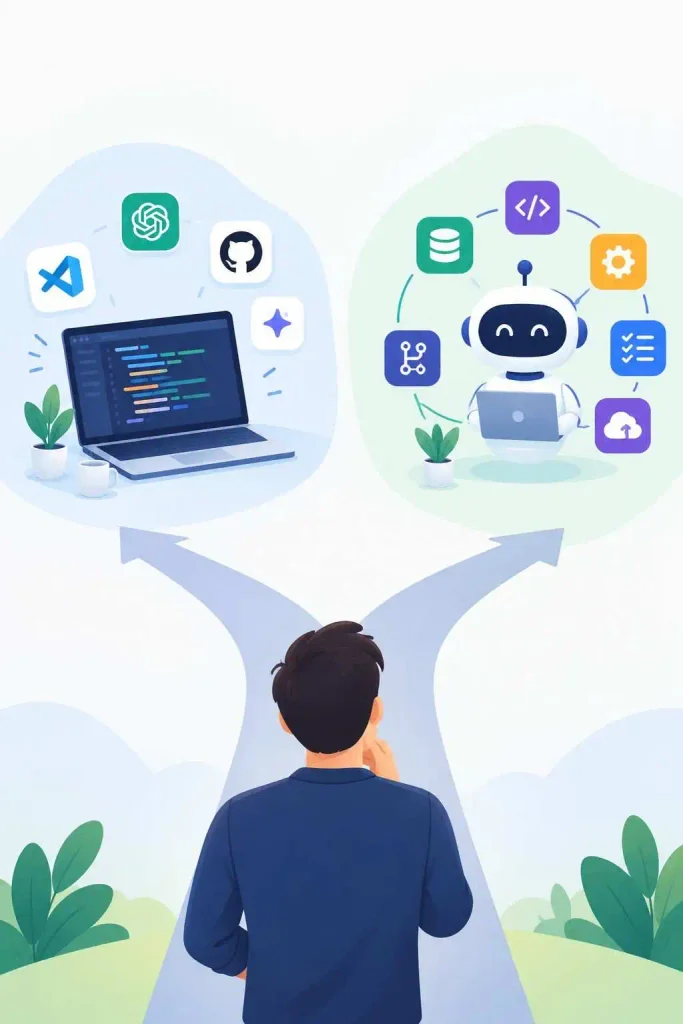
This is the real decision facing engineering leaders today: do you adopt a ready-made AI coding assistant, or do you invest in a custom-built AI agent designed around your own codebase, tools, and processes? Both paths work. Neither is automatically better. At Appbirds Technologies, this exact question comes up in nearly every conversation with growing product and engineering teams, because the right answer changes depending on what a team is actually trying to solve.
What Are AI Coding Tools?
AI coding tools are software applications that use large language models to help developers write, review, debug, refactor, or test code. They range from simple autocomplete plugins inside an IDE to advanced systems that can plan multi-step tasks, edit several files, and run commands with minimal supervision. Most modern AI coding tools sit somewhere between a smart assistant and a semi-autonomous collaborator.
Why Basic Code Completion Is No Longer Enough
Early AI coding tools mostly predicted the next line of code. That was useful, but limited. Developers still had to manage context switching, write tests separately, track technical debt, and coordinate changes across files by hand.
Modern engineering teams need more than suggestions. They need systems that understand:
- The structure of an entire repository, not just one file
- Internal coding standards and architectural patterns
- Existing tickets, pull requests, and documentation
- How a change in one service affects another
This is where the conversation shifts from simple assistance to something closer to delegation.
From Assistance to Autonomy: The Real Shift Underway
The center of gravity in AI-assisted development is moving. It started with autocomplete, moved to chat-based help, and is now heading toward agents that can independently execute defined tasks writing a feature branch, running tests, fixing a failing build, or opening a pull request.
This shift from assistance to autonomy is the thread running through this entire comparison. Off-the-shelf AI coding tools already offer a version of this autonomy. Custom-built agents push it further, tailored to a specific engineering environment.
How Off-the-Shelf AI Coding Tools Work
Commercial AI coding tools are built to work broadly, across many languages, frameworks, and team sizes, right out of the box.
Core Capabilities
- Code generation and completion inside popular IDEs
- Conversational debugging, where a developer describes a bug and gets suggested fixes
- Automated code review, flagging style issues, security risks, or logic errors
- Test generation for existing functions and endpoints
- Documentation support, turning code into readable explanations
Where They Fit Best
Off-the-shelf AI coding tools work well when a team wants fast adoption, minimal setup, and proven reliability across common development tasks. They’re maintained by vendors with large research teams, which means frequent model improvements without any internal engineering effort.
What Are Custom-Built AI Agents?
A custom-built AI agent is a system designed specifically around a company’s own codebase, internal tools, business logic, and approval workflows. Instead of adapting the team to the tool, the tool is built around the team.
Custom agents are typically built using foundation models accessed through an API, combined with internal data, custom instructions, and integrations into systems like ticketing platforms, CI/CD pipelines, or internal APIs. They can be scoped narrowly for example, an agent that only handles inventory-sync bug fixes or broadly, handling multiple categories of engineering work.
Off-the-Shelf AI Coding Tools vs Custom-Built Agents
| Factor | Off-the-Shelf AI Coding Tools | Custom-Built AI Agents |
| Setup Time | Days | Weeks to months |
| Customization | Limited to vendor settings | Fully tailored to internal workflows |
| Data Handling | Governed by vendor policy | Controlled internally |
| Cost Structure | Subscription-based | Development plus maintenance cost |
| Integration Depth | Standard IDE and repo integrations | Deep integration with internal systems |
| Maintenance | Handled by vendor | Owned by internal or partner team |
| Best Fit | General coding tasks, fast adoption | Company-specific, high-volume, or sensitive workflows |
Real-World Scenarios
A few practical situations make the difference clearer.
- A startup building its first product adopts an off-the-shelf AI coding assistant so its small team can move faster without hiring extra engineers.
- A retail platform running dozens of microservices builds a custom agent that automatically checks pull requests against internal architecture rules before a human reviewer even looks at them.
- An e-commerce company managing seasonal traffic spikes uses a custom agent to auto-generate load-testing scripts ahead of major sales events.
- A software agency serving multiple clients combines both: off-the-shelf AI coding tools for day-to-day development, and a custom agent for repetitive client-specific deployment tasks.
None of these examples require guessing. They reflect how teams typically discover which approach fits, often after starting with the simpler option first.
Benefits of Off-the-Shelf AI Coding Tools
- Fast time to value, often within a single sprint
- Lower upfront cost than building anything internally
- Continuous model improvements from the vendor
- Broad language and framework support
- Easier onboarding for new developers
Benefits of Custom-Built AI Agents
- Deep alignment with internal architecture and standards
- Full control over data handling and security policies
- Ability to automate company-specific, repetitive engineering tasks
- No dependency on a single vendor’s roadmap
- Long-term flexibility as the codebase evolves
AI Coding Tool Use Cases
| Use Case | How It Works | Business Benefit |
| Automated code review | AI scans pull requests for bugs, style, and security issues | Fewer defects reaching production |
| Bug triage assistant | AI reads error logs and suggests likely root causes | Faster incident resolution |
| Test case generation | AI writes unit tests based on existing functions | Higher test coverage with less manual effort |
| Internal documentation agent | AI converts code and comments into readable docs | Reduced onboarding time for new developers |
| Deployment automation agent | Custom agent runs pre-deployment checks automatically | Fewer failed or delayed releases |
Challenges to Consider
Adopting AI coding tools, whether off-the-shelf or custom, comes with real trade-offs.
- Data security and privacy, especially with proprietary code
- Integration complexity with legacy systems
- Cost of maintaining a custom agent over time
- Model limitations, including occasional incorrect suggestions
- Change management, since developers need training to trust and verify AI output
- Vendor dependency for off-the-shelf tools, and internal skill dependency for custom agents
None of these challenges are reasons to avoid AI coding tools altogether. They’re reasons to plan the adoption deliberately.
A Practical Framework for Deciding
Step 1: Map your current bottlenecks. Identify where engineering time is actually being lost — code review, testing, debugging, or documentation.
Step 2: List your non-negotiables. Data privacy rules, compliance requirements, and integration constraints often decide the answer before cost does.
Step 3: Pilot an off-the-shelf tool first. It’s the fastest way to measure real impact with minimal risk.
Step 4: Track specific metrics. Cycle time, pull request turnaround, and defect rates tell you more than general satisfaction surveys.
Step 5: Identify recurring, high-volume tasks. These are strong candidates for a custom agent.
Step 6: Build narrow, not broad. A custom agent that does one thing reliably beats one that tries to do everything.
Step 7: Reassess quarterly. Both the tools and your engineering needs will keep changing.
AI Coding Tools Adoption Checklist
- Defined which engineering tasks need AI support
- Confirmed data privacy and compliance requirements
- Selected a pilot team and success metrics
- Evaluated at least two off-the-shelf AI coding tools
- Reviewed integration requirements with existing systems
- Estimated build and maintenance cost for any custom agent
- Assigned clear ownership for monitoring AI-generated code
- Planned a feedback loop with developers
Common Mistakes to Avoid
- Choosing a custom agent before testing off-the-shelf options
- Ignoring data security requirements during tool selection
- Rolling out AI coding tools without developer training
- Measuring adoption instead of measuring actual impact
- Letting AI-generated code skip normal review standards
- Building a custom agent with no clear ownership after launch
- Assuming one tool fits every team inside the organization
The Future of AI Coding Tools and Agents
Current AI coding tools already handle code generation, review, and basic debugging well. The next phase, already emerging, involves agents that can plan multi-step engineering tasks with less human intervention coordinating across a pull request, a test suite, and a deployment pipeline in one flow.
This doesn’t mean fully autonomous engineering teams are close. It means the boundary between “assistant” and “collaborator” will keep moving, and teams that build strong review and governance habits now will adapt faster as that boundary shifts.
Why Choose Appbirds Technologies
Appbirds Technologies works with product and engineering teams to evaluate, implement, and where needed, build custom AI coding agents suited to their specific systems. This includes assessing existing workflows, integrating AI coding tools into CI/CD pipelines, and developing custom agents for companies whose needs go beyond what off-the-shelf tools can offer. The goal is a setup that fits how a team actually works, not a generic implementation.
FAQs
What are AI coding tools?
AI coding tools are software applications powered by large language models that assist developers with writing, reviewing, testing, and debugging code. They range from simple autocomplete features to advanced systems capable of multi-step, semi-autonomous tasks across a codebase.
Are off-the-shelf AI coding tools secure enough for enterprise use?
Security depends on the vendor’s data handling policies, not the category of tool itself. Enterprises should review data retention, model training practices, and compliance certifications before adopting any AI coding tool, off-the-shelf or custom.
When does it make sense to build a custom AI agent instead of using an off-the-shelf tool?
Custom agents make sense when a team has repetitive, high-volume tasks specific to its own systems, strict data control requirements, or workflows that off-the-shelf tools can’t reach through standard integrations.
Can small teams benefit from AI coding tools?
Yes. Small teams often see the fastest returns from off-the-shelf AI coding tools because they lack the resources to build custom infrastructure, and even modest gains in speed have an outsized impact on a small engineering team.
Do AI coding tools replace developers?
No. Current AI coding tools assist with generation, review, and testing, but still require human judgment for architecture decisions, business logic, and final code approval. They change how developers work, not whether they’re needed.
Conclusion
The choice between off-the-shelf AI coding tools and custom-built AI agents isn’t about which is more advanced. It’s about matching the tool to the actual bottleneck a team is trying to solve. Most organizations get the best results by starting with proven AI coding tools, learning where the real friction is, and building custom agents only where the return clearly justifies the investment.
If your team is weighing off-the-shelf AI coding tools against a custom-built agent, Appbirds Technologies can help you evaluate the right path for your engineering workflow. Get in touch with our team o discuss your specific requirements.