LLM in healthcare software is changing how hospitals approach patient communication, documentation, information retrieval, and workflow automation. But LLMs, LAMs, and RAG are not interchangeable technologies.
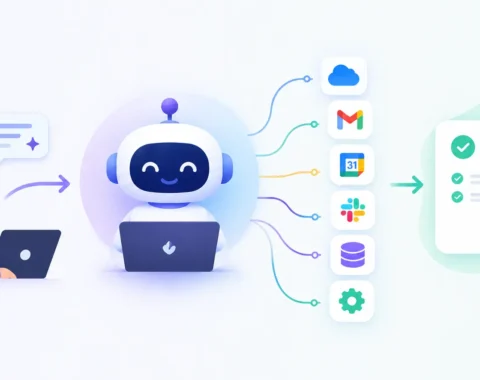
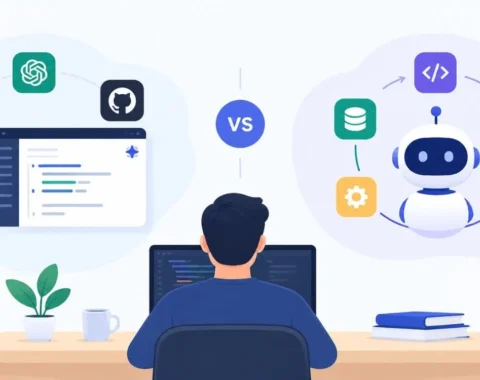
An LLM understands and generates language. RAG retrieves relevant information to ground AI responses. LAMs and agentic AI systems are designed to use tools and perform actions across software and workflows.
For hospital decision-makers, the important question isn’t which acronym sounds most advanced. It’s which technology fits the specific workflow, data, security requirements, and level of automation needed.
A Practical Healthcare AI Architecture
A production healthcare AI application typically includes more than an AI model.
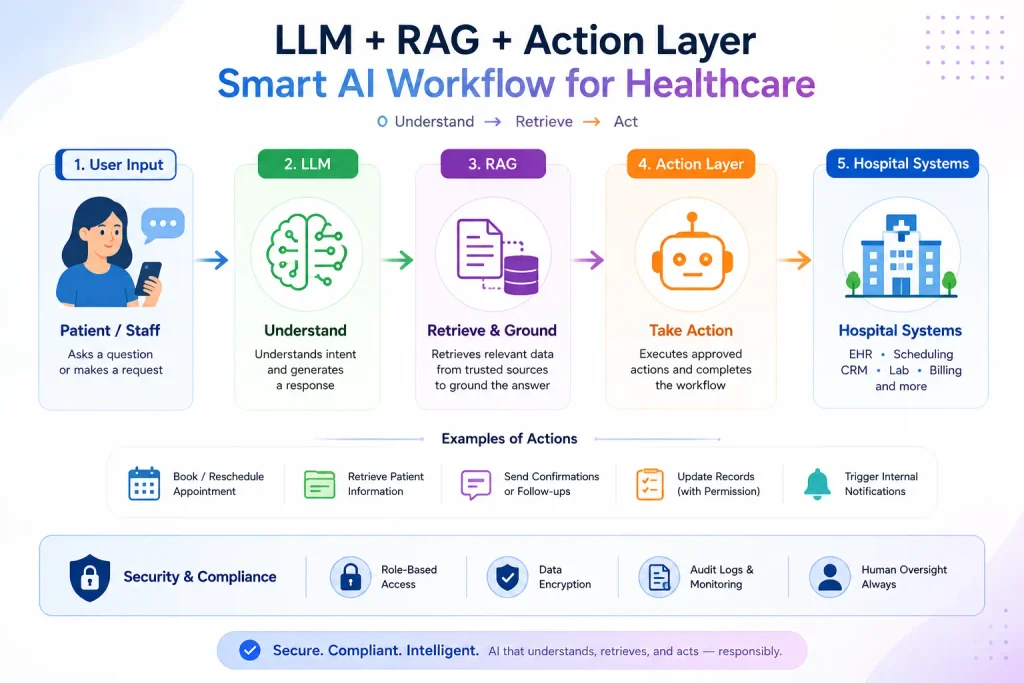
LLM in Healthcare Software: What Does an LLM Actually Do?
A Large Language Model (LLM) is an AI model designed to understand and generate human language. Models such as GPT, Gemini, and Claude can summarize information, answer questions, extract data, generate content, and support conversational applications.
Myth: LLMs can replace clinical decision-making
Reality: LLMs can support healthcare professionals, but they should not automatically be treated as independent clinical decision-makers.
For example, an LLM could summarize a patient’s medical history for a clinician. It can make the information easier to review, but the clinician remains responsible for interpreting the information and making the appropriate decision.
Common healthcare uses of LLMs
- Patient communication and FAQs
- Healthcare chatbots
- Documentation assistance
- Information extraction
- Text summarization
- Administrative support
- Staff assistance
- Natural-language interfaces
The key point is that an LLM provides language intelligence. The surrounding application determines how that intelligence is used.
What Is a LAM in Healthcare?
LAM stands for Large Action Model. It is a newer and less standardized term than LLM.
Generally, a LAM describes an AI system designed to translate a user’s intent into actions across applications or workflows. Many of these capabilities overlap with AI agents, agentic AI, and tool-using LLM systems.
For example, instead of simply telling a patient how to book an appointment, an action-oriented AI system could potentially:
- Understand the patient’s request
- Check available appointment slots
- Present suitable options
- Receive confirmation
- Book the appointment through an authorized system
- Send a confirmation message
LAM vs LLM: What’s the difference?
| Capability | LLM | LAM / Action-Oriented AI |
| Understand language | Yes | Yes |
| Generate text | Yes | Usually |
| Retrieve information | With tools/RAG | Usually |
| Use external tools | Possible | Core capability |
| Execute workflows | Not inherently | Designed for this |
| Interact with applications | Possible | Central use case |
Myth: LAMs are simply LLMs with extra features
Reality: The distinction is mainly about what the overall system can do. An LLM focuses on understanding and generating language, while action-oriented systems are designed to interact with tools and execute defined workflows. Related reading: AI Chatbots vs AI Agents
For healthcare applications, permissions and validation are critical. An AI system should never have unrestricted access to hospital systems simply because it can perform actions.
What Is RAG in Healthcare?
RAG stands for Retrieval-Augmented Generation.
RAG allows an AI system to retrieve relevant information from approved sources and provide that information to an LLM as context before generating an answer.
In RAG in healthcare, sources might include:
- Hospital policies
- Internal procedures
- Approved medical knowledge
- Patient information where properly authorized
- Appointment data
- Operational documents
- Healthcare knowledge bases
The simplified process is:
User question → Retrieve information → LLM generates response → Apply validation and safety controls
Myth: RAG eliminates AI hallucinations
Reality: RAG can reduce unsupported answers, but it does not guarantee accuracy.
Problems can still occur when:
- The wrong information is retrieved
- Documents are outdated
- Data is incomplete
- Multiple sources conflict
- Permissions are incorrectly configured
- The model misinterprets the retrieved information
RAG should therefore be viewed as a grounding mechanism, not a complete safety solution.
LLM vs LAM vs RAG: The Simple Explanation
Think about their roles this way:
LLM = Understand and generate
RAG = Find and ground
LAM / Agentic AI = Take action
These technologies can work together rather than competing with each other.
How LLM, RAG, and Action-Oriented AI Work Together
Consider an AI-powered patient intake assistant.
A patient says:
“I’d like to schedule a follow-up appointment with the same department.”
Step 1: LLM understands the request
The LLM identifies the patient’s intent and extracts relevant information from the conversation.
Step 2: RAG retrieves relevant information
The system retrieves authorized information such as previous appointment details, department information, or hospital scheduling policies.
Step 3: Action-oriented AI executes the workflow
If the system has the required permissions and integrations, it can interact with the scheduling system, show available appointments, receive confirmation, and complete the booking.
The architecture becomes:
LLM → Understand
RAG → Ground
Action layer → Execute
This is the difference between an AI chatbot that only answers questions and an AI system that can support an actual healthcare workflow.
A Practical Healthcare AI Architecture
A production healthcare AI application typically includes more than an AI model.
Patient / Staff
↓
AI Interface
Web app, mobile app, chatbot, or staff dashboard
↓
LLM
Understands requests and generates responses
↓
RAG / Retrieval Layer
Retrieves approved and relevant information
↓
APIs & Tools
Connects with scheduling, EHR, CRM, ERP, messaging, or other systems
↓
Action / Agent Layer
Executes authorized workflows
↓
Security & Governance
Permissions, monitoring, audit logs, validation, and human oversight
This architecture is why building healthcare AI is more than simply connecting a chatbot to an LLM API.
RAG in Healthcare vs a Standalone LLM
| Feature | Standalone LLM | LLM + RAG |
| General language understanding | Yes | Yes |
| Internal hospital knowledge | Limited | Can retrieve approved information |
| Current internal policies | Not guaranteed | Can retrieve current sources |
| Patient-specific information | Requires integration | Can retrieve authorized information |
| Grounding | Limited | Stronger when retrieval works correctly |
| Hallucination risk | Exists | Reduced, not eliminated |
RAG can improve the relevance of responses, but the quality of the underlying data and retrieval system still matters.
2 Common Myths About AI in Healthcare
Myth 1: Every hospital needs an autonomous AI agent
Reality: Not every workflow needs agentic AI.
A hospital FAQ assistant may only require an LLM and a curated knowledge base. A scheduling system may need API integrations. A complex multi-step workflow may benefit from an agentic architecture.
The right technology depends on the problem.
Myth 2: Connecting AI to hospital software is easy
Reality: The AI model is only one part of the implementation.
Healthcare applications may require:
- EHR integration
- API development
- Authentication
- Role-based permissions
- Encryption
- Audit logging
- Data governance
- Monitoring
- Human escalation
- Workflow validation
This is where experienced healthcare AI software development becomes important.
Healthcare AI Compliance and Data Privacy
Healthcare AI must be evaluated not only by what the model can do, but also by how patient and organizational data is handled.
Depending on the country and use case, organizations may need to consider:
- HIPAA and other applicable regulations
- Data residency
- Encryption
- Authentication
- Access control
- Audit logs
- Data retention
- Vendor agreements
- EHR integration
- Patient consent
Cloud AI vs On-Device AI
Cloud AI can provide access to powerful models and scalable infrastructure, but sensitive data requires appropriate security and governance.
On-device or edge AI can reduce some data-transfer requirements, but it may have limitations around hardware, model size, updates, and performance.
There is no single best architecture. The decision should depend on the application’s data sensitivity, infrastructure, performance requirements, and regulatory environment.
What Should Hospital Decision-Makers Look For?
Instead of asking, “Do we need an LLM, LAM, or RAG?” , start with the workflow.
1. What problem are you solving?
Is the goal to improve documentation, patient communication, information retrieval, scheduling, or administrative automation?
2. What information does the AI need?
Does it need general knowledge, internal documents, real-time operational data, or authorized patient information?
3. Does the AI need to take action?
If the system only answers questions, LLM + RAG may be enough.
If it needs to interact with software systems, tools and agentic capabilities may be required.
4. How much human oversight is needed?
The more consequential the action, the more important validation, approval, and escalation become.
5. How will the system be secured and monitored?
AI should have only the permissions it needs to perform its tasks, and nothing more. The system should only access the data and tools required for its specific purpose.
Where Generative AI Can Deliver Value in Hospital Software
Practical healthcare AI applications include:
- AI patient assistants
- Appointment support
- Documentation assistance
- Healthcare information retrieval
- Internal employee assistants
- Patient intake
- Referral coordination
- Administrative automation
- Document summarization
- Healthcare knowledge search
- Workflow notifications
- Multilingual patient communication
The strongest applications usually have a clearly defined workflow, reliable data sources, appropriate integrations, and measurable outcomes. AI agents can also help businesses automate multi-step tasks and operational workflows when the use case requires more than simple information retrieval or content generation. Learn more about AI agents for business.
Which Technology Does Your Healthcare Application Need?
There is no universal winner.
Choose an LLM when you need:
- Natural-language interaction
- Summarization
- Text generation
- Classification
- Conversational interfaces
Consider RAG when you need:
- Organization-specific information
- Frequently updated knowledge
- Internal policies
- Grounded responses
- Search across approved documents
Consider Agentic or Action-Oriented AI when you need:
- Multi-step workflows
- Tool usage
- Application interaction
- Automated task execution
- Scheduling or operational actions
Many modern healthcare applications will use a combination of these capabilities.
The Future of AI in Healthcare Is More Than a Chatbot
Healthcare AI is moving from simple question-and-answer systems toward applications that can understand context, retrieve information, use software tools, and support multi-step workflows.
But greater autonomy should not be the goal by itself.
A successful healthcare AI system should be:
- Useful
- Secure
- Auditable
- Permission-aware
- Integrated with existing workflows
- Transparent about limitations
- Designed with appropriate human oversight
The real opportunity is not simply putting an LLM inside hospital software. It is building an architecture where LLMs, retrieval systems, APIs, workflow automation, security controls, and human expertise work together.
Frequently Asked Questions
Is RAG safer than a standalone LLM for healthcare?
RAG can make responses more grounded by retrieving information from approved sources, but it does not guarantee accuracy or safety. Data quality, retrieval, permissions, model behavior, and human oversight still matter.
Can a LAM replace hospital staff?
Action-oriented AI can automate specific repetitive workflows, but it should not automatically be considered a replacement for healthcare staff. High-impact workflows require appropriate authorization, validation, monitoring, and escalation.
LLM vs. LAM: How Are They Different?
An LLM primarily understands and generates language. A LAM is a newer term generally used for systems designed to turn natural-language intent into actions across applications and workflows. These capabilities overlap with AI agents and agentic AI.
What is RAG in healthcare?
RAG, or Retrieval-Augmented Generation, retrieves relevant information from approved sources and provides it to an LLM as context before generating a response. It can be used with internal policies, knowledge bases, and appropriately authorized healthcare data.
Is generative AI HIPAA-compliant?
Generative AI is not automatically HIPAA-compliant simply because it is used in healthcare. Compliance depends on the complete system, including data handling, security, access controls, vendor arrangements, and intended use.
What is agentic AI in healthcare?
Agentic AI refers to systems that can pursue a defined goal through multiple steps while potentially using tools, APIs, databases, and software applications. Healthcare examples can include appointment workflows, administrative automation, information retrieval, and patient support.
How Appbirds Can Help
Building healthcare AI requires more than connecting an API to a chatbot.
Appbirds can help healthcare organizations design and develop AI-powered software around real operational requirements, including AI chatbots, mobile applications, web platforms, workflow automation, API integrations, and intelligent software solutions.
Have a healthcare workflow you want to improve with AI? Talk to Appbirds about building a practical AI solution for your organization.