A working API is not the same as a working healthcare integration. Most failures happen after the connection test succeeds in data mapping, workflow design, compliance gaps, and long-term maintenance. This guide breaks down the real reasons healthcare integrations fail and what teams can do differently.
Introduction
The API responds. The status code says 200. The demo goes smoothly. Then, three weeks after go-live, a nurse can’t find a lab result, a billing record shows the wrong patient, or a scheduling update never reaches the EHR.
This is the quiet crisis behind most healthcare integration projects. Teams treat the API connection as the finish line, when it’s actually the starting point. A successful integration depends on dozens of decisions that have nothing to do with whether an endpoint returns valid JSON.
At Appbirds Technologies, we’ve seen this pattern repeat across hospitals, health-tech startups, and enterprise software providers. The API was never the problem. The system around it was.
What is Healthcare Integration?
Healthcare integration is the process of connecting different clinical and administrative systems EHRs, lab systems, billing platforms, scheduling tools so they can exchange accurate patient data automatically, without manual re-entry.
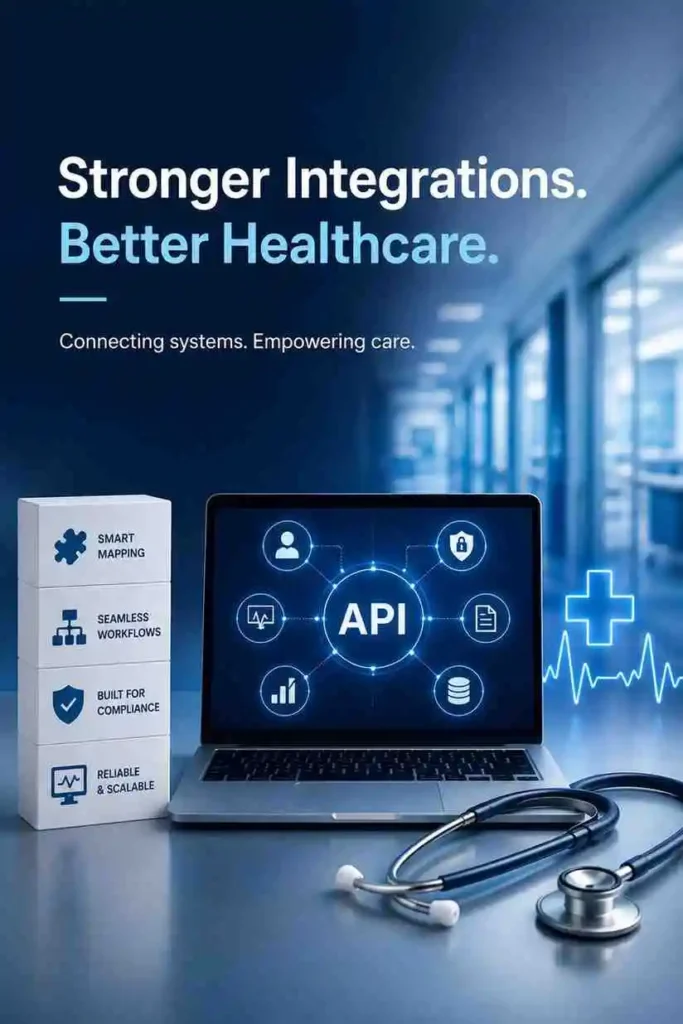
It goes beyond a single API call. True healthcare integration includes data mapping, authentication, error handling, compliance controls, and ongoing monitoring. It’s a full data pipeline, not a single connection point.
Standards like HL7, FHIR, and SMART on FHIR define how this data should be structured and shared. But following a standard doesn’t automatically mean the integration works in the real world, with real patient records and real clinical workflows.
Why Healthcare Integrations Matter
Every hospital and health-tech platform runs on data that has to move correctly between systems. When healthcare integration works well, it removes double data entry, reduces clinical errors, and speeds up decisions that affect patient care.
When it doesn’t work, the damage compounds. A missed lab update can delay treatment. A broken scheduling sync can cause missed appointments. A duplicate patient record can trigger billing disputes.
This is why healthcare interoperability isn’t just an IT concern , it’s a patient safety and business continuity issue.
Why Healthcare Integrations Fail Even When APIs Work
Here’s the core truth: an API can pass every test and the healthcare integration can still fail in production. That’s because APIs only prove connectivity. They don’t prove correctness.
A few reasons this happens:
- The API returns data, but the fields don’t map correctly to the receiving system’s schema.
- Authentication works in testing but breaks under token expiration or refresh cycles in production.
- The integration handles normal cases but fails silently on edge cases like merged patient records or amended lab results.
- Data arrives on time in a sandbox, but real-world network conditions and system load introduce delays that break downstream workflows.
The API is a doorway. What happens once data walks through that door how it’s transformed, validated, stored, and acted on is where most healthcare integration projects actually break down.
Common Technical Challenges
How does data mapping cause integration failures?
Patient data mapping fails when two systems define the same field differently. A “status” field in one EHR might mean something entirely different in another. Without careful field-level mapping, data gets misrepresented even though the API call itself succeeds.
Other recurring technical issues include:
- Data transformation errors between HL7 v2 messages and FHIR resources
- API rate limits that throttle high-volume data exchange during peak hours
- Legacy systems that only support outdated HL7 versions or flat-file exports
- Authentication and OAuth token handling that isn’t built for long-running, unattended processes
- Real-time data exchange requirements that legacy infrastructure simply can’t support
- Lack of proper monitoring and logging, so failures go unnoticed for days
Why does authentication break healthcare integrations?
OAuth and token-based authentication often works fine in a test environment but fails once integrations run continuously in production. Token refresh cycles, session timeouts, and inconsistent scopes across systems are common causes of intermittent, hard-to-diagnose failures.
Common Business Challenges
Technical issues get most of the attention, but business-side gaps cause just as many failures:
- No clear owner for the integration after go-live
- Clinical teams weren’t consulted on workflow impact before launch
- Vague requirements that don’t account for real-world data exceptions
- No budget allocated for ongoing maintenance and monitoring
- Compliance and legal review happens too late in the project
A healthcare integration is never “done” at launch. It needs an owner, a budget, and a maintenance plan just like any other critical system.
Real-World Examples
A mid-sized clinic connected its scheduling software to its EHR using a vendor-provided API. The connection tested perfectly. Two months later, staff noticed that appointment cancellations weren’t syncing back, and patients were being called for visits that no longer existed. The API worked. The two-way sync logic didn’t.
In another case, a health-tech startup built a FHIR-based integration for lab results. It worked for standard results but broke whenever a lab amended or corrected a result after the fact. The original API design never accounted for that scenario, because it wasn’t part of the initial testing.
These aren’t rare edge cases. They’re the normal reality of healthcare data, which is messy, corrected often, and rarely as clean as a sandbox environment.
API vs. True Healthcare Integration
| Aspect | API Connectivity | True Healthcare Integration |
| Scope | Single request/response | Full data lifecycle across systems |
| Testing | Happy-path scenarios | Edge cases, exceptions, corrections |
| Data handling | Raw data transfer | Mapped, validated, transformed data |
| Compliance | Often an afterthought | Built in from the start (HIPAA, GDPR) |
| Monitoring | Rarely included | Continuous logging and alerting |
| Ownership | Developer-level | Cross-functional, ongoing |
Signs Your Healthcare Integration Will Fail
Watch for these early warning signs:
- No one has mapped every field between systems, only the “important” ones
- Testing only covers standard, clean data scenarios
- There’s no monitoring or alerting plan for after go-live
- Compliance and security review happens after development is finished
- Clinical staff haven’t been involved in workflow testing
- The project timeline has no budget for post-launch fixes
Best Practices for Successful Healthcare Integration
- Map data at the field level, not just at the system level.
- Test with real-world data patterns, including corrections, duplicates, and merges.
- Build in HIPAA and GDPR compliance from day one, not as a final review step.
- Use middleware or an integration platform to decouple systems and handle transformation logic centrally.
- Set up monitoring and logging so failures are caught in minutes, not weeks.
- Design for scalability so the integration handles growth in data volume and new endpoints.
- Involve clinical and operations teams early, not just at UAT.
Healthcare Integration Checklist
| Checklist Item | Status |
| Field-level data mapping documented | ☐ |
| Authentication tested under real production load | ☐ |
| Edge cases (corrections, duplicates, merges) tested | ☐ |
| HIPAA/GDPR compliance reviewed | ☐ |
| Monitoring and logging configured | ☐ |
| Rate limits and scalability tested | ☐ |
| Clinical workflow sign-off completed | ☐ |
| Post-launch support plan defined | ☐ |
Common Mistakes to Avoid
- Treating a successful API test as proof the integration is complete
- Ignoring how legacy systems handle real-time data exchange
- Skipping documentation of data transformation rules
- Underestimating the ongoing cost of monitoring and support
- Assuming HL7 or FHIR compliance alone guarantees compatibility
Future Trends
Healthcare integration is shifting toward standardized, API-first architectures built around FHIR and SMART on FHIR, driven by interoperability regulations in the US, UK, and Australia. Expect wider adoption of healthcare automation for routine data reconciliation, more emphasis on real-time data exchange over batch processing, and growing use of integration platforms that reduce custom point-to-point connections. Security and consent management will also become more granular as patient data sharing expands across more systems.
Why Choose Appbirds Technologies
Building a healthcare integration that actually holds up in production takes more than API documentation. It takes experience with real clinical workflows, compliance requirements, and the messy exceptions that live systems throw at you every day.
Appbirds Technologies works with healthcare startups, SaaS providers, and hospitals to design integrations that are mapped correctly, tested against real-world data, and monitored long after go-live. If your team is planning an integration project, our contact page is a good place to start the conversation, or learn more about our approach on our home page.
FAQs
What is healthcare integration?
Healthcare integration is the process of connecting clinical and administrative systems like EHRs, labs, and billing platforms so patient data flows between them automatically and accurately, without manual re-entry or duplicate records.
Why does a healthcare integration fail even when the API works?
An API only proves systems can connect, not that data is mapped, transformed, and validated correctly. Failures usually happen in data mapping, edge-case handling, and workflow design, not in the connection itself.
What standards are used in healthcare integration?
The most common standards are HL7 (especially HL7 v2) and FHIR, with SMART on FHIR used for secure, app-based access to EHR data. Each defines how patient data should be structured and exchanged between systems.
How much time does it take to complete a healthcare integration?
Most healthcare integration projects take about 8 to 16 weeks, depending on system complexity covering data mapping, compliance checks, real-world testing, and monitoring after launch.
HL7 vs. FHIR: What sets them apart?
HL7 v2 uses older, message-based formatting common in legacy EHR systems. FHIR is a newer, web-friendly standard built on REST APIs, making it easier to integrate with modern applications and SMART on FHIR tools.
Conclusion
A working API is the easy part of any healthcare integration project. The hard part is everything after it correct data mapping, real-world testing, compliance, and long-term monitoring. Teams that treat integration as an ongoing system, not a one-time connection, are the ones that avoid the failures described here.
If your healthcare integration keeps breaking after launch, it’s worth a second look before the next go-live. Reach out to Appbirds Technologies through our contact page, or visit our home page to see how we approach healthcare integration projects that are built to last.