Walk into almost any boardroom today and someone is talking about Enterprise AI. Budgets have gone up. Vendors are knocking. Pilots are running in every department. And yet, when leadership asks “what did we actually get from this?” the room often goes quiet.
That’s the strange part of this moment. Enterprise AI has never been more available, more talked about, or more funded. But for a lot of companies, the results still aren’t showing up in the numbers that matter revenue, cost, speed, customer satisfaction. This article looks at why that gap exists, and more importantly, what to do about it.
What Is Enterprise AI?
Enterprise AI means using artificial intelligence across the actual operations of a business not just in one team’s side project. It touches customer service, sales, finance, HR, IT, and operations at the same time, and it’s meant to run continuously, not just for a demo.
How Enterprise AI Differs From Traditional AI
Traditional AI projects were often built for one narrow task: a fraud detection model, a recommendation engine, a chatbot. Enterprise AI is different in scope. It’s meant to work across systems, departments, and decisions which is exactly why it’s harder to get right. A model that works well in a lab doesn’t automatically work well inside a messy, real company with 15-year-old software and five different data formats.
Why Is Enterprise AI Everywhere?
A few things pushed Enterprise AI into every strategy deck at once:
● Generative AI made the technology visible and easy to try, almost overnight
● Competitors started announcing AI initiatives, and nobody wanted to be left behind
● Software vendors added “AI” to nearly every product update
● Leadership teams faced pressure from boards and investors to “have an AI strategy”
None of that is necessarily wrong. But it means a lot of AI adoption happened because of pressure and hype, not because of a clear business problem that needed solving. That’s the root of a lot of what comes next.
Why Aren’t Businesses Seeing Results From Enterprise AI?
Here’s the honest answer: it’s rarely because the AI isn’t smart enough. Today’s models are genuinely capable. The problem is almost always what happens around the model the data feeding it, the workflow it’s supposed to fit into, and the people expected to use it.
Enterprise AI only creates business value when it’s connected to real workflows, real data, real decisions, and outcomes someone is actually tracking. Skip any one of those, and you get an impressive demo that never turns into a business result.
The Enterprise AI-to-Outcome Gap
Think of it as five connected steps:
AI Capability → AI Implementation → Workflow Integration → Employee Adoption → Business Outcome
Most companies invest heavily in the first link — buying or building the AI capability and assume the rest will follow on its own. It doesn’t.
A few examples of where the chain breaks:
● Customer support: A company deploys an AI chatbot (capability), but it isn’t connected to the CRM or order history (integration breaks), so agents still have to re-explain context to customers. No time saved.
● Sales: An AI tool scores leads (capability), but sales reps don’t trust the scores and keep using their own gut instinct (adoption breaks).Within three months, the tool often goes unused.
● Finance: An AI model flags anomalies in spend (capability), but no one owns the follow-up process, so flagged items just pile up (workflow breaks).
● HR: A resume-screening AI is implemented (capability), but recruiters weren’t trained on how to use its output alongside their own judgment (adoption breaks), so it gets quietly ignored.
Notice the pattern in every case, the AI worked. The chain around it didn’t.

The Biggest Challenges Blocking Enterprise AI ROI
1. Poor Data Quality
The problem: AI is only as good as the data it learns from and works with.
Why it happens: Years of manual entry, duplicate records, and disconnected spreadsheets pile up quietly until someone tries to build something on top of them.
Business impact: Inaccurate predictions, wrong recommendations, and teams that stop trusting the AI’s output.
Example: A retailer’s AI demand-forecasting tool kept over-ordering stock because product categories were labeled inconsistently across three different systems.
How to solve it: Start with a data quality audit before choosing any AI tool. Fix the plumbing before installing new machinery.
2. Fragmented Enterprise Systems
The problem: AI needs to pull from multiple systems to be useful, but most enterprises run on a patchwork of tools that don’t talk to each other.
Why it happens: Systems get added over time a new CRM here, a legacy ERP there with no single owner responsible for how they connect.
Business impact: AI tools end up working with partial information, producing incomplete or misleading outputs.
Example: A finance AI tool couldn’t reconcile numbers because the accounting system and the billing platform used different customer IDs.
How to solve it: Map your core systems and prioritize integration before layering AI on top.
3. Lack of Clear Business Objectives
The problem: Many Enterprise AI projects start with “let’s try AI” instead of “let’s solve this specific business problem.”
Why it happens: Pressure to “do something with AI” leads teams to pick a tool first and figure out the goal later.
Business impact: Projects that technically work but don’t move any metric leadership actually cares about.
How to solve it: Every AI initiative should start with one sentence: “This will reduce/increase [specific metric] by [target] within [timeframe].”
4. AI Projects Without ROI Metrics
The problem: If nobody defined success upfront, nobody can prove success later.
Why it happens: Teams get excited about the technology and skip the boring but essential step of setting a baseline.
Business impact: Leadership loses confidence in AI spending because there’s no way to show it worked.
How to solve it: Set a baseline metric before launch, and review it on a fixed schedule monthly or quarterly, not “someday.”
5. Pilot Projects That Never Scale
The problem: A pilot succeeds in one team or region, then quietly stays there forever.
Why it happens: Pilots are often built with shortcuts, manual workarounds, or a single champion holding it together none of which survive contact with the rest of the company.
Business impact: Wasted investment and a growing list of “AI experiments” that never became real products.
How to solve it: Design pilots with scale in mind from day one same data standards, same governance rules you’d use company-wide.
Data: The Hidden Foundation of Enterprise AI
It’s worth repeating: most Enterprise AI failures trace back to data. Not because companies don’t have enough of it most have plenty but because it’s scattered, inconsistent, or simply untrustworthy.
Before expanding an AI project, ask yourself three questions:
● Is our data accurate and up to date?
● Is it stored in a way multiple systems can access?
● Does someone own the responsibility of keeping it clean?
If any answer is no, address that issue before moving forward. AI on top of bad data doesn’t fix the data it just makes bad decisions faster.
Why AI Pilots Often Fail to Scale
Pilots are supposed to prove an idea works. But a lot of pilots prove something narrower: that the idea works in one controlled corner of the business, with one motivated team, under close attention. That’s not the same as proving it’ll work everywhere.
Common reasons pilots stall:
● The pilot relied on manual cleanup that isn’t sustainable at scale
● Success was measured by enthusiasm, not by numbers
● If the person driving the project moves on or switches teams, momentum can quickly disappear.
● No budget was set aside for what comes after the pilot
If you want a pilot to become a real program, define what “graduating” from pilot to full rollout actually requires before you start.
The Role of AI Agents and Automation
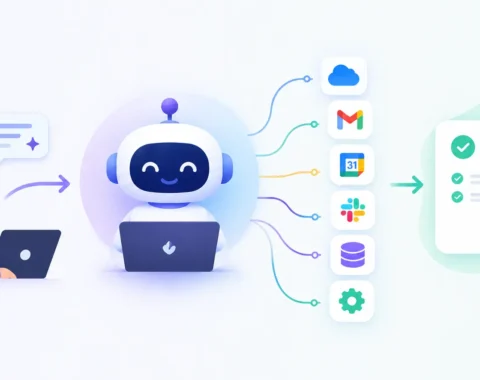
AI agents systems that can take multi-step actions, not just answer a single question are where a lot of Enterprise AI value is starting to show up. Instead of just recommending an action, an AI agent can pull data from a system, take a next step, and flag a human only when needed.
Used well, AI agents can:
● Automatically triage and route customer support tickets
● Pull data from multiple systems to prepare a report before a meeting
● Flag and pre-fill routine approvals so people only review exceptions
● Handle repetitive back-office steps in finance or HR
The key word is “used well.” An AI agent connected to bad data or an undefined process just automates the mess faster.
How to Turn Enterprise AI Into Measurable Business Outcomes
This is where the real issue lies.Turning Enterprise AI into results comes down to five shifts:
1. Start with the business problem, not the tool. Pick the metric first, then find the AI approach that moves it.
2. Fix the data before scaling the model. Clean, connected data beats a fancier algorithm every time.
3. Design for the whole workflow, not just the AI step. Map what happens before and after the AI touches the process.
4. Give someone real ownership. A named person or team accountable for the outcome, not just the deployment.
5. Track it like any other investment. Set a baseline, measure regularly, and be willing to say when something isn’t working.
Enterprise AI Implementation Framework
A simple framework to keep initiatives grounded:
| Stage | What Happens | Key Question |
| 1. Define | Pick the business problem and target metric | What are we actually trying to improve? |
| 2. Prepare | Clean and connect the relevant data | Is our data ready to support this? |
| 3. Pilot | Test with real users, real data, real constraints | Does this hold up outside the lab? |
| 4. Integrate | Build the AI into daily workflows and systems | Will people actually use this every day? |
| 5. Scale | Roll out company-wide with governance in place | Can this run without constant hand-holding? |
| 6. Measure | Review results against the original baseline | Did we move the metric we set out to move? |
How to Measure Enterprise AI ROI
ROI on Enterprise AI isn’t just about cost savings. Depending on the use case, it can show up as:
● Time saved — hours no longer spent on manual tasks
● Cost reduced — lower operational spend per transaction or ticket
● Revenue impact — faster sales cycles, higher conversion, better upsell targeting
● Error reduction — fewer mistakes in compliance-heavy or repetitive processes
● Customer experience — faster response times, higher satisfaction scores
Pick two or three of these that matter most to your business, set a baseline before rollout, and review on a fixed schedule. Vague enthusiasm isn’t a metric.
Enterprise AI: From Experimentation to Execution
| AI Experimentation | Enterprise AI |
| Small pilots | Business-wide implementation |
| Technology-focused | Outcome-focused |
| Short-term testing | Long-term transformation |
| Isolated tools | Integrated systems |
| Demo success | Business success |
| Innovation metrics | ROI and business KPIs |
Experimentation is useful it’s how you learn what works. But a company that stays in experimentation mode forever never gets the compounding benefit that comes from AI being woven into daily operations. Moving from one to the other means shifting your yardstick from “did the demo go well” to “did the KPI move.”
Enterprise AI Best Practices
● Choose one clear business problem per initiative don’t try to fix everything with one tool
● Involve the people who’ll actually use the tool from day one, not after launch
● Set a data quality baseline before you set an AI performance target
● Assign a single owner accountable for outcomes, not just for deployment
● Build lightweight governance early it’s easier than retrofitting it later
● Review results on a fixed calendar, not “when someone remembers”
● Be willing to shut down or redesign initiatives that aren’t working
Enterprise AI Checklist
● Business problem and target metric clearly defined
● Baseline measurement taken before rollout
● Data quality reviewed and cleaned where needed
● Relevant systems mapped and integration plan in place
● Named owner accountable for outcomes
● End users involved in design and testing
● Governance and security review completed
● Workflow redesigned around the AI, not just bolted on
● Scale plan defined before pilot begins
● Review cadence scheduled (monthly/quarterly)
Frequently Asked Questions
What is Enterprise AI?
Enterprise AI is the use of artificial intelligence across a company’s core operations — customer service, sales, finance, HR, and more — rather than in a single isolated tool
Why do Enterprise AI projects fail?
Most fail due to poor data quality, weak system integration, unclear ownership, or a lack of defined business goals not because the underlying AI is weak.
What are the biggest Enterprise AI challenges?
Data quality, system fragmentation, unclear objectives, weak governance, and pilots that never scale past their original team.
How can businesses measure Enterprise AI ROI?
By setting a baseline before rollout and tracking specific metrics like time saved, cost reduced, error rates, or revenue impact on a regular schedule.
How can businesses scale Enterprise AI beyond a pilot?
By designing pilots with company-wide data standards and governance from the start, and defining upfront what “ready to scale” actually looks like.
Key Takeaways
● Enterprise AI struggles are rarely about the AI itself they’re about data, workflows, and ownership.
● The gap between AI capability and business outcome has five links: capability, implementation, integration, adoption, and outcome. Any weak link breaks the chain.
● Pilots that succeed in isolation often fail to scale because they relied on manual shortcuts or a single champion.
● Clean, connected data is the real foundation of Enterprise AI not the model itself.
● AI agents can extend Enterprise AI from advice-giving to actual task completion, but only on top of a solid workflow.
● ROI should be defined and measured before rollout, not guessed at afterward.
● Enterprise AI works best as a business transformation effort with a named owner not a side project handed entirely to IT.\
- At Appbirds Technologies, we believe Enterprise AI works best when treated as a business transformation initiative with clear ownership — not simply as an IT side project.
Conclusion
Enterprise AI is not short on intelligence. It’s short on execution. The companies actually getting results aren’t necessarily using smarter models they’re the ones who fixed their data, redesigned their workflows, and put someone accountable for the outcome.
If your company has invested in Enterprise AI and the results still aren’t showing up, the fix usually isn’t a new tool. It’s closing the gap between what the AI can do and how your business actually runs.
That’s the work Appbirds Technologies helps businesses do turning Enterprise AI from a pile of separate experiments into something that actually moves the numbers you care about.
Talk to an Enterprise AI Team
If your Enterprise AI initiatives are stuck in pilot mode, it might be worth a second look at how they’re connected to your data and workflows. Talk to Appbirds Technologies about building an Enterprise AI strategy that’s designed to scale from day one.