Introduction
An AI agent for your business is an intelligent system that makes autonomous decisions, learns from interactions, and understands context – unlike traditional chatbots that just respond to pre-programmed questions.
Companies implementing AI agents are seeing impressive results:
- 40–60% cost reductions
- 70–85% automation rates for routine tasks
- ROI within 6–12 months
Whether you’re a startup, mid-market company, or enterprise, building an AI agent tailored to your needs can transform operations and drive measurable growth.
This comprehensive guide walks you through everything needed to successfully develop and deploy an AI agent for your business.
What is an AI Agent?
An AI agent is an intelligent system designed to:
- Perceive its environment
- Make decisions autonomously
- Take actions
- Continuously learn from outcomes with minimal human intervention
AI Agents vs Traditional Chatbots
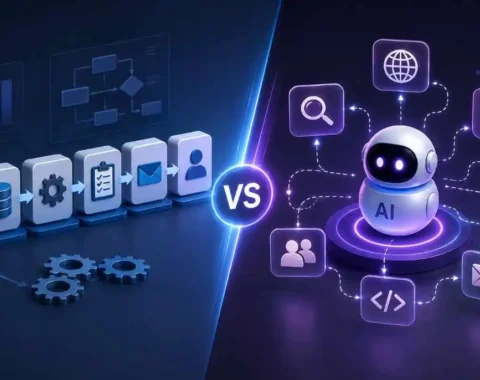
A traditional chatbot follows predefined decision trees and matches phrases to pre-written responses.
An AI agent:
- Understands customer intent
- Accesses relevant business data
- Evaluates policies and workflows
- Makes informed decisions independently
This is why businesses are increasingly investing in custom AI agent development instead of simple chatbots.
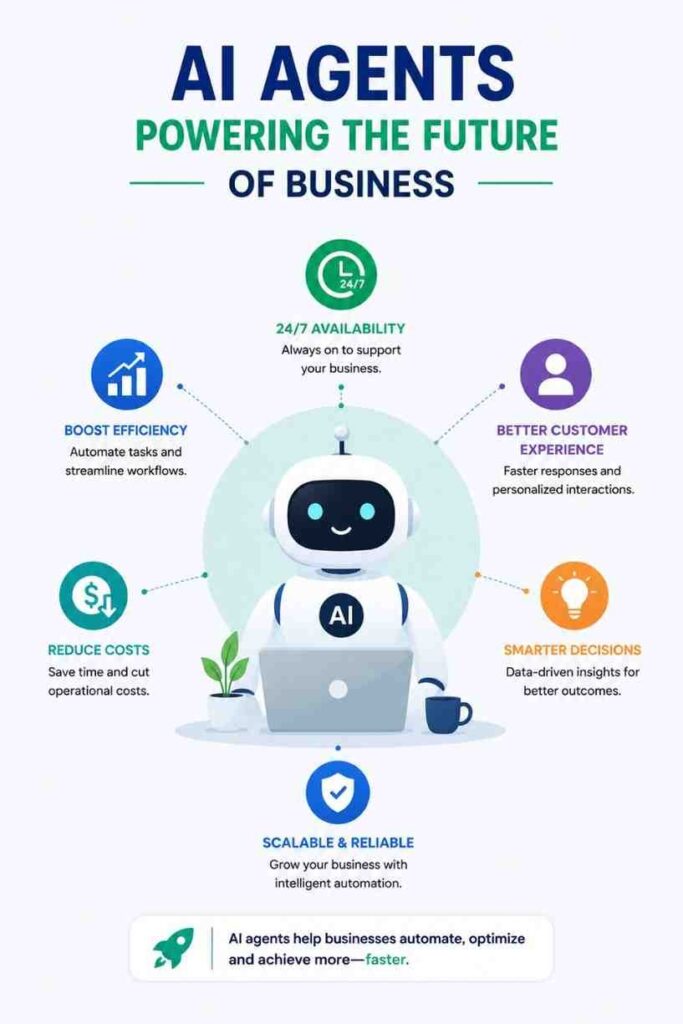
Why Build an AI Agent for Your Business?
Cost Reduction and Efficiency
AI agents automate repetitive tasks that consume employee time daily.
Examples include:
- Customer support queries
- Lead qualification
- Data entry
- Invoice processing
- Appointment scheduling
By automating these tasks, businesses can reduce operational costs significantly while allowing employees to focus on strategic work.
Many businesses begin noticing measurable returns from AI implementation within the first 6–12 months.
24/7 Customer Service
Modern customers expect quick and reliable support at any time, no matter where they are located.
An AI agent:
- Works 24/7
- Never takes breaks
- Provides consistent support quality
- Reduces customer wait times
This leads to higher customer satisfaction and better conversion rates.
Personalization at Scale
Modern customers expect personalized experiences.
AI agents can deliver:
- Personalized product recommendations
- Tailored communication
- Customized support experiences
- Individualized marketing interactions
And they can do this simultaneously for thousands of users.
Data-Driven Insights
Companies collect and process large volumes of data every single day.
AI agents analyze this data in real time to:
- Identify patterns
- Predict trends
- Detect risks
- Surface insights quickly
This enables faster and smarter business decisions.
Competitive Advantage
Companies adopting intelligent automation gain advantages such as:
- Faster customer acquisition
- Higher retention rates
- Improved operational efficiency
- Better customer experiences
Businesses that delay AI adoption risk falling behind competitors already using advanced automation.
Types of AI Agents for Business
1. Customer Service AI Agents
Used for:
- Support tickets
- FAQs
- Troubleshooting
Benefits
- 24/7 support
- Faster response times
- Reduced support costs
2. Sales and Lead Generation Agents
Used for:
- Lead qualification
- Demo scheduling
- Sales follow-ups
Benefits
- Higher conversion rates
- Faster sales cycles
- Improved lead management
3. Operations AI Agents
Used for:
- Inventory management
- Invoice processing
- Workflow automation
Benefits
- Lower operational costs
- Better efficiency
- Reduced human error
4. Analytics AI Agents
Used for:
- Demand forecasting
- Churn prediction
- Business intelligence
Benefits
- Strategic insights
- Proactive planning
- Better decision-making
5. HR and Recruiting Agents
Used for:
- Resume screening
- Candidate communication
- Employee onboarding
Benefits
- Faster hiring
- Better candidate experience
- Reduced manual work
6. Content Management Agents
Used for:
- Knowledge retrieval
- Document organization
- Internal information access
Benefits
- Faster information retrieval
- Reduced onboarding time
- Better productivity
Key Technologies Used in AI Agent Development
| Technology | Purpose | Example Tools | Main Benefit |
| Large Language Models (LLMs) | Power conversations and reasoning | GPT-4, Claude, Gemini | Human-like understanding and responses |
| Retrieval-Augmented Generation (RAG) | Connect AI with business knowledge | LangChain, LlamaIndex | More accurate and context-aware answers |
| Vector Databases | Store and retrieve AI embeddings | Pinecone, Weaviate | Fast semantic search and data retrieval |
| Natural Language Processing (NLP) | Understand customer intent and language | spaCy, NLTK | Better communication and intent detection |
| APIs & Integrations | Connect AI agents with business systems | CRM APIs, ERP Integrations | Workflow automation and seamless operations |
Step-by-Step Implementation Guide
Step 1: Define Your Business Problem
Clearly identify:
- The problem you want to solve
- Business objectives
- Success metrics
- Budget and timeline
Without a clearly defined goal, AI projects often fail.
Step 2: Assess Current Systems and Data
Evaluate:
- Existing systems
- Data quality
- Integration requirements
- Privacy and compliance needs
Poor-quality data is one of the biggest reasons AI implementations fail.
Step 3: Choose Your AI Architecture
Popular approaches include:
RAG (Retrieval-Augmented Generation)
Ideal for customer support and knowledge-based systems.
LLMs (Large Language Models)
Used for advanced reasoning and conversational intelligence.
Specialized Machine Learning Models
Best for prediction-focused use cases.
Many businesses use hybrid architectures for better performance.
Step 4: Prepare Training Data
This step includes:
- Cleaning data
- Organizing datasets
- Labeling information
- Structuring workflows
Businesses should dedicate 20–30% of project timelines to data preparation.
Step 5: Build and Train Your AI Agent
Businesses commonly use:
- TensorFlow
- PyTorch
- OpenAI
- Claude
- Google AI models
Development includes:
- Prompt engineering
- Workflow configuration
- Behavioral testing
- Continuous refinement
Step 6: Implement Governance and Safety Controls
Important controls include:
- Compliance safeguards
- Audit trails
- Escalation systems
- Cost management
- Output validation
Strong governance ensures responsible AI deployment.
Step 7: Pilot Testing and Refinement
Before full deployment:
- Test with a smaller user group
- Collect feedback
- Monitor results
- Improve workflows
Pilot testing reduces deployment risks significantly.
Step 8: Full Deployment and Monitoring
After successful testing:
- Deploy at scale
- Continuously monitor performance
- Track KPIs
- Update models regularly
AI systems require ongoing optimization to remain effective.
Best Practices for AI Agents for Business Success
- Define clear success metrics before development
- Involve business and technical stakeholders early
- Start with low-risk automation opportunities
- Monitor performance continuously
- Train employees on new systems
- Create feedback loops for improvements
- Plan for long-term maintenance and updates
Why Choose Appbirds Technologies
At Appbirds Technologies, we’ve built custom AI agents for businesses across industries.
We focus on tailored solutions instead of one-size-fits-all systems.
Our clients achieve:
- 40–60% cost reduction in operations
- 70–85% automation of routine tasks
- 25–35% improvement in conversion rates
- ROI within 9–15 months
We handle:
- Discovery
- Strategy
- Development
- Integration
- Optimization
from start to finish.
Ready to transform your business? Get in touch with Appbirds Technologies to explore the right AI solution for your business.
FAQ
Q: What businesses can benefit from AI agents?
A: AI agents can help startups, mid-sized companies, and enterprises automate operations, improve customer support, increase sales efficiency, and reduce manual workload across multiple departments.
Q: How long does implementation take?
A: Pilot projects take 8-12 weeks. Full-scale deployment takes 4-6 months depending on data availability and requirements clarity.
Q: Can AI agents integrate with existing business systems?
A: Yes. AI agents can integrate with CRMs, ERP systems, databases, payment platforms, customer support tools, and communication software through APIs and automation workflows.
Q: How do we prevent AI bias?
A: Audit training data before use, test across demographic groups, implement fairness constraints, and monitor real-world performance.
Conclusion
AI agents are helping businesses automate work, improve customer experiences, and operate more efficiently. With the right strategy and implementation, they can create real long-term business growth.
Businesses investing in AI agents for business today are building smarter, faster, and more scalable operations for the future.
If you’re planning to build a custom AI agent for your business, Appbirds Technologies can help you develop a solution tailored to your goals and workflows.