Mobile apps are entering a smarter era, and agentic AI in mobile app development is driving this shift.
For years, apps relied on fixed user flows and manual actions. But today, users expect apps that can understand intent, automate tasks, and help them achieve outcomes faster.
Unlike traditional AI that simply responds to prompts, agentic AI can reason, plan, make decisions, and take action autonomously. This is transforming mobile apps from passive interfaces into intelligent experiences.
For businesses, this is more than a technology trend. It is changing how digital products are built, how users interact with apps, and how companies compete in modern markets.
At Appbirds Technologies, we’re seeing growing demand for AI-powered mobile solutions across healthcare, fintech, logistics, and enterprise industries. In this guide, we explore what agentic AI in mobile app development means and why it matters in 2026.
What Is Agentic AI?
Most AI systems today are reactive.
Most chatbots simply respond to commands or questions. You upload data, and the AI generates a prediction or recommendation. The system responds to an input, but it doesn’t independently pursue a goal.
Agentic AI works differently.
Instead of simply responding, it can:
- understand objectives
- break tasks into steps
- decide which actions to take
- use external tools and APIs
- adapt when conditions change
- continue working with minimal human input
Think of traditional AI as a calculator.
Agentic AI is closer to a digital employee that understands what you want accomplished and figures out how to get there.
Agentic AI vs Traditional AI
| Feature | Traditional AI | Agentic AI |
| Behavior | Reactive | Goal-oriented |
| User Interaction | Prompt → Response | Goal → Multi-step execution |
| Decision Making | Limited | Autonomous |
| Tool Usage | Minimal | Extensive |
| Adaptability | Low | High |
| Workflow Handling | Single-step | Multi-step |
| Example | Chatbot | AI assistant managing workflows |
This is why agentic AI is emerging as one of the most transformative trends in software development.
What Are AI Agents?
AI agents are the systems powered by agentic AI behavior.
An AI agent can:
- interact with users
- access APIs
- retrieve information
- automate tasks
- coordinate workflows
- make contextual decisions
For example, an AI travel assistant inside a mobile app could:
- check your calendar
- monitor flight prices
- suggest hotels
- book reservations
- update schedules automatically
All from a single high-level instruction.
That level of autonomy is what separates AI agents from traditional app features.
How Agentic AI Works Inside Mobile Apps
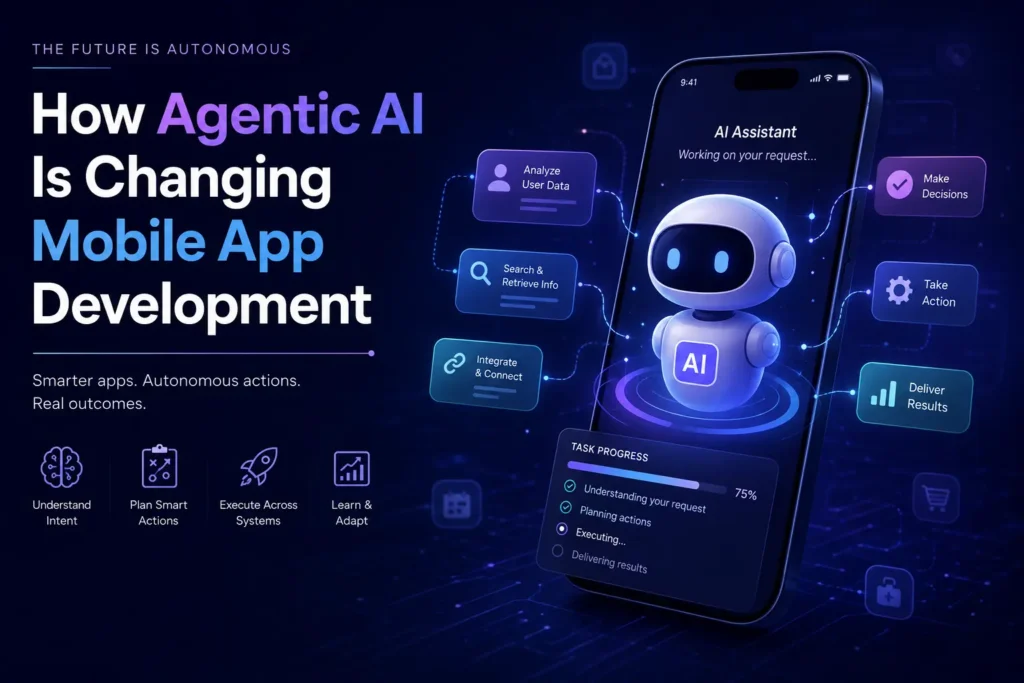
Traditional apps rely heavily on hardcoded user journeys. Agentic AI-powered apps operate more dynamically.
Here’s how a typical workflow works.
1. Understanding User Intent
The system analyzes:
- user behavior
- app context
- historical activity
- connected data
- current goals
Instead of only reacting to taps or commands, the app understands what the user is actually trying to accomplish.
2. Planning Actions
After understanding the user’s goal, the AI divides the process into smaller actionable steps.
For example:
- deciding which APIs to call
- determining workflow order
- selecting relevant information
- prioritizing tasks
This planning layer is what gives the app adaptive intelligence.
3. Executing Tasks
The AI agent can then:
- trigger workflows
- process transactions
- query databases
- automate forms
- send notifications
- interact with external systems
The user no longer has to manually complete every step.
4. Learning and Adapting
Modern agentic systems continuously evaluate outcomes.
If something fails:
- the AI adjusts strategy
- retries actions
- requests clarification
- modifies workflows
This creates apps that improve experiences dynamically over time.
How Agentic AI in Mobile App Development Is Changing the Industry
The effects are already visible in various industries.
Smarter User Experiences
Apps are becoming proactive instead of reactive.
A finance app can detect unusual spending activity and alert users before they even realize there’s an issue. A health app may recommend appointments based on biometric trends. A productivity app may automate repetitive workflows automatically.
Users increasingly expect apps to reduce effort rather than simply provide information.
Automation of Complex Tasks
Agentic AI can automate processes that previously required multiple screens and manual steps.
Examples include:
- booking services
- expense categorization
- inventory management
- customer support workflows
- report generation
- appointment scheduling
This dramatically improves efficiency and user satisfaction.
Faster Development of Adaptive Features
Traditional mobile apps depend on developers defining every possible user journey manually.
Agentic architectures allow mobile apps to adapt dynamically, reducing development complexity for many intelligent workflows.
Development teams can prioritize outcomes and user experience instead of relying on rigid app workflows.
New Categories of AI-Native Apps
Entirely new mobile product categories are emerging:
- autonomous productivity assistants
- AI-powered healthcare companions
- intelligent enterprise workflow apps
- AI-driven customer support platforms
- autonomous shopping assistants
These products are redefining what users expect from software.
How Agentic AI Is Being Used in Real Mobile Apps
Healthcare Apps
An intelligent healthcare app can:
- monitor patient vitals
- identify risk patterns
- notify care providers
- schedule appointments
- recommend interventions
All while continuously adapting to patient data.
E-Commerce Apps
Instead of basic product recommendations, AI agents can:
- understand shopping preferences
- compare pricing
- apply discounts
- track inventory
- complete purchases automatically
The shopping experience becomes highly personalized and frictionless.
Fintech Applications
Financial apps powered by agentic AI can:
- categorize expenses
- optimize budgets
- detect suspicious activity
- automate savings
- generate financial reports
This reduces manual financial management for users.
Enterprise and Logistics Apps
Field service platforms can automatically:
- assign technicians
- optimize routes
- order replacement parts
- generate service reports
- notify customers
This significantly reduces operational overhead.
Challenges of Agentic AI in Mobile Apps
While the opportunity is massive, businesses also need to understand the challenges.
Privacy and Data Security
Agentic AI platforms often rely on sensitive user data and connections with external systems or services. Strong security architecture and responsible AI design are essential.
Reliability and Accuracy
AI agents can make mistakes if systems are poorly designed or insufficiently monitored. Human oversight remains important for high-risk workflows.
API and Infrastructure Complexity
Building autonomous mobile experiences requires:
- scalable backend systems
- API orchestration
- AI infrastructure
- monitoring systems
- secure integrations
This is why choosing the right development partner matters.
Ethical and Responsible AI Use
Businesses must clearly define:
- what actions AI can take
- where human approval is required
- how decisions are logged
- how user data is protected
Businesses that implement AI responsibly are gaining a stronger competitive edge.
What Agentic AI Means for Businesses
The shift toward intelligent mobile experiences is happening quickly.
Companies that embrace this shift early will gain a strong competitive edge:
- stronger user retention
- lower operational costs
- better customer experiences
- improved automation
- competitive differentiation
More importantly, user expectations are changing.
People increasingly expect apps to:
- anticipate needs
- automate workflows
- reduce manual effort
- deliver contextual assistance
The businesses that create these intelligent experiences early will define the future of digital products.
Why the Right AI Development Team Makes a Difference
Building AI-powered mobile apps is no longer just about UI design or frontend development.
Successful agentic AI products require expertise in:
- mobile app architecture
- AI orchestration
- backend systems
- API integrations
- cloud infrastructure
- security
- responsible AI implementation
At Appbirds Technologies, we help startups and enterprises design and develop intelligent mobile applications that combine modern app experiences with advanced AI capabilities.
Whether you’re building a new AI-native product or evolving an existing app, the right technical foundation matters.
Frequently Asked Questions
What is agentic AI in mobile app development?
Agentic AI refers to AI systems inside mobile apps that can plan, make decisions, use tools, and complete tasks autonomously instead of only responding to prompts.
What Sets AI Agents Apart from Agentic AI?
AI agents are the actual software systems performing tasks. Agentic AI refers to the autonomous behavior and intelligence that powers those systems.
Is agentic AI safe for mobile applications?
Yes, when implemented responsibly with strong security practices, clear permissions, monitoring systems, and human oversight for sensitive actions.
Which industries benefit most from agentic AI?
Healthcare, fintech, logistics, e-commerce, enterprise productivity, and customer service platforms are currently seeing the fastest adoption.
Can existing mobile apps integrate agentic AI?
In many cases, yes. Agentic AI features can often be integrated through APIs and modular AI systems without rebuilding the entire app from scratch.
How long does it take to build an AI-powered mobile app?
Project timelines vary depending on complexity. Focused AI features may take 8–12 weeks, while fully AI-native applications can take several months.
Final Thoughts
Agentic AI is changing mobile app development from static interfaces into intelligent, adaptive experiences capable of helping users achieve real outcomes.
This shift goes far beyond chatbots or automation tools. It represents a new generation of software where apps can reason, act, and improve workflows autonomously.
For businesses, the opportunity is significant.
The apps that succeed over the next few years will be the ones that reduce friction, automate complexity, and provide genuinely intelligent assistance.
At Appbirds Technologies, we help businesses build modern mobile experiences powered by AI, automation, and scalable technology.
If you’re planning an AI-powered mobile product, now is the right time to start exploring what agentic AI can do for your business.