Introduction
Healthcare ERP software for hospitals is an integrated digital solution that helps healthcare organizations manage patient services, finance, billing, inventory, HR, and operational workflows through a single platform. Unlike traditional patient record systems, Healthcare ERP helps hospitals improve efficiency, automate processes, reduce operational challenges, and make data-driven decisions.
Traditional healthcare systems often focus only on storing patient information. However, running a hospital successfully requires a connected platform that manages both clinical and business operations. This is where Healthcare ERP solutions help by integrating multiple departments into a single digital ecosystem.
With automation, real-time analytics, and AI-powered capabilities, healthcare ERP software enables hospitals to improve efficiency, reduce operational costs, and make faster data-driven decisions.
The demand for these solutions is growing rapidly. The global healthcare ERP market was valued at approximately USD 8 billion in 2024 and is projected to nearly double to USD 16 billion by 2034, growing at a CAGR of around 7%. Hospitals worldwide are recognizing that disconnected systems are no longer sustainable and ERP is becoming a core part of healthcare infrastructure.
Summary: Why Healthcare ERP Software for Hospitals Matters
Healthcare ERP software for hospitals provides a centralized platform that connects patient management, finance, inventory, HR, pharmacy, analytics, and compliance processes.
EHR systems focus on patient care documentation, while healthcare ERP software manages the complete hospital ecosystem, including finance, inventory, HR, billing, and operational workflows. They help healthcare providers:
- Reduce manual processes and paperwork
- Improve billing and revenue management
- Optimize inventory and medical supply usage
- Enhance communication between departments
- Generate real-time business insights
- Support future AI-driven healthcare operations
A modern hospital requires more than digital patient records. Healthcare organizations need an intelligent ERP system that helps administrators streamline operations, maximize resource utilization, reduce costs, and improve patient outcomes.
What Is Healthcare ERP Software for Hospitals?
Healthcare ERP software for hospitals is an integrated enterprise management system designed specifically for healthcare organizations. It connects different departments through a centralized database, allowing seamless information sharing and workflow automation.
A complete healthcare ERP solution manages:
- Patient registration and appointment scheduling
- Billing and insurance claim management
- Pharmacy and inventory operations
- Employee management and payroll
- Procurement and vendor management
- Financial reporting
- Compliance tracking
- Business analytics
The goal of healthcare ERP is to create a connected hospital environment where every department works with accurate and updated information.
Types of Healthcare ERP Software for Hospitals
Healthcare organizations can choose different types of ERP solutions based on their operational needs, budget, and scalability requirements.
Cloud-Based Healthcare ERP Software
Cloud-based ERP allows hospitals to access their systems securely from anywhere. It reduces infrastructure costs, provides automatic updates, and supports scalability. Cloud adoption is accelerating and is expected to see the highest growth rate among all deployment types through 2034.
On-Premise Healthcare ERP Software
On-premise ERP gives hospitals complete control over their servers, security, and data management. It is suitable for organizations with strict infrastructure requirements. Currently, on-premise deployments hold the largest market share, particularly among larger hospital networks.
Custom Healthcare ERP Software
Custom healthcare ERP software is developed according to specific hospital workflows, integrations, and business goals. It provides better flexibility compared to standard solutions. Purpose-built healthcare ERP solutions can simplify implementation by reducing unnecessary customization compared to generic ERP systems adapted for healthcare needs.
Why Healthcare ERP Software Goes Beyond Patient Records
Patient records are only one part of hospital management. Healthcare organizations also need to manage complex operational challenges every day.
Without an integrated ERP system, hospitals often face:
- Separate systems across departments
- Manual data entry and duplication
- Delayed billing processes
- Inventory shortages or wastage
- Difficulty tracking hospital performance
- Limited visibility into financial operations
Healthcare ERP software for hospitals solves these challenges by creating a single source of information. Doctors, administrators, finance teams, and management can access relevant data quickly and make better decisions.
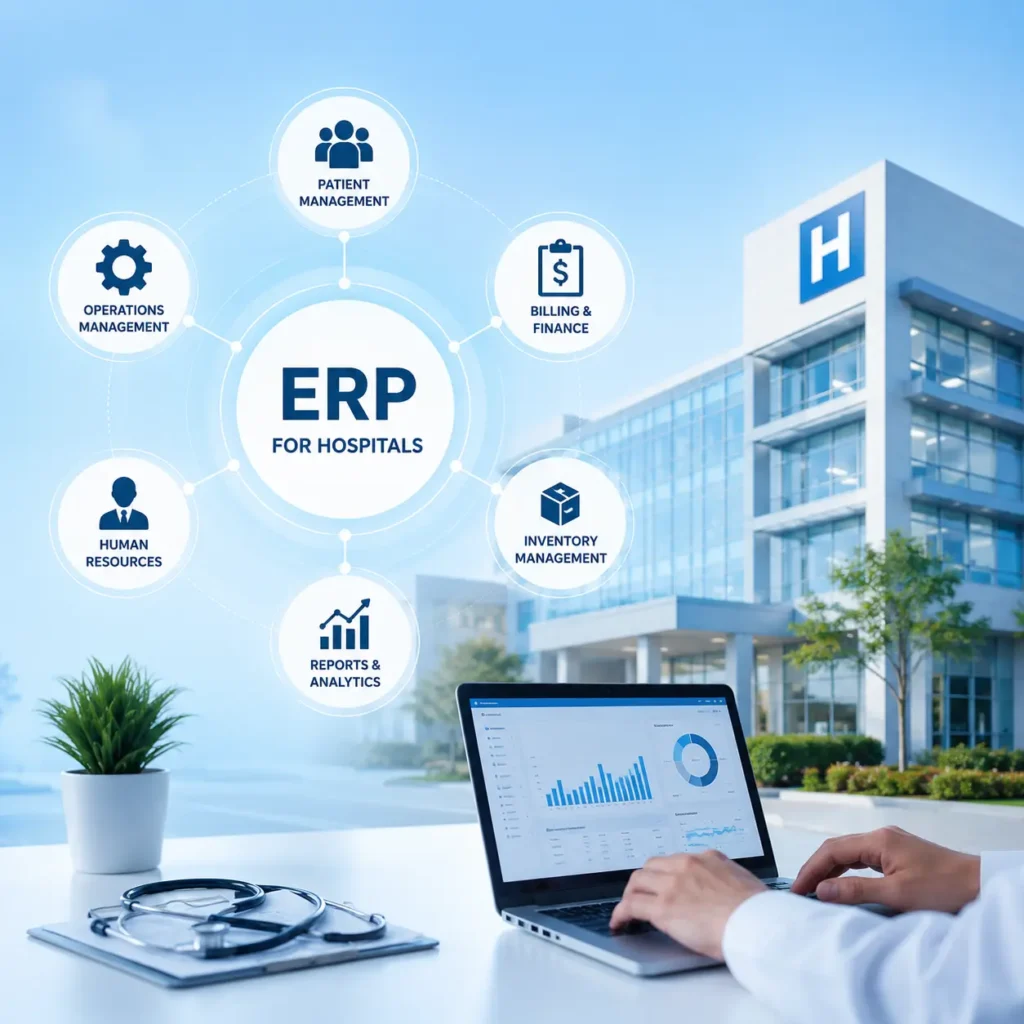
Healthcare ERP Software Modules Every Hospital Needs
A successful healthcare ERP implementation includes multiple modules that support different hospital functions.
| ERP Module | Purpose | Key Benefits |
| Patient Management | Handles appointments, admissions, discharge, and patient information | Improves patient experience and workflow |
| Finance & Billing | Manages payments, insurance claims, and accounting | Reduces billing errors and improves cash flow |
| Inventory Management | Tracks medicines, equipment, and supplies | Prevents stock shortages and reduces waste |
| Pharmacy Management | Manages medicine availability and prescriptions | Improves pharmacy operations |
| Human Resource Management | Handles employee records, payroll, and scheduling | Optimizes workforce management |
| Analytics Dashboard | Provides reports and business insights | Enables data-driven decisions |
| Compliance Management | Tracks audits and regulatory requirements | Improves healthcare compliance |
Key Benefits of Healthcare ERP Software for Hospitals
1. Centralized Hospital Data Management
Healthcare ERP software for hospitals eliminates data silos by connecting different departments on one platform.
Instead of maintaining separate systems for billing, pharmacy, HR, and inventory, hospitals can manage everything through an integrated solution.
This improves:
- Data accuracy
- Communication between teams
- Operational transparency
- Decision-making speed
2. Improved Patient Experience
Patients expect faster services, accurate billing, and easy access to healthcare information.
ERP systems help hospitals improve patient journeys through:
- Faster registration processes
- Reduced waiting times
- Quick access to patient history
- Better coordination between departments
Optimized healthcare operations help hospitals deliver faster services, improve care coordination, and enhance the overall patient experience.
3. Better Financial Management
Managing hospital finances is complex because of multiple payment sources, insurance claims, and operational expenses.
Healthcare ERP software helps automate:
- Billing processes
- Insurance claim management
- Revenue tracking
- Expense monitoring
- Financial reporting
This helps hospitals reduce revenue leakage and improve financial control.
4. Efficient Inventory and Supply Chain Management
Medical supplies and medicines must always be available, but overstocking increases costs.
Healthcare ERP provides real-time inventory visibility and helps hospitals:
- Track stock levels
- Monitor expiry dates
- Automate purchase requests
- Manage suppliers
- Reduce wastage
This ensures hospitals have the right resources at the right time.
Business Impact of Healthcare ERP Software for Hospitals
Healthcare ERP software helps hospitals achieve measurable improvements by automating repetitive tasks and improving operational visibility.
Key improvements include:
- Reduced manual paperwork through workflow automation
- Faster billing and insurance claim processing
- Better inventory tracking and reduced medical supply wastage
- Improved coordination between departments
- Faster decision-making through real-time analytics
Healthcare ERP Software vs EHR System: Understanding the Difference
| Feature | EHR System | Healthcare ERP Software |
| Primary Focus | Patient medical records | Complete hospital operations |
| Main Users | Doctors and medical staff | Doctors, administrators, finance teams, management |
| Billing Management | Limited | Advanced billing and revenue management |
| Inventory Management | Not available | Complete inventory control |
| HR Management | Not available | Integrated employee management |
| Analytics | Clinical reports | Business and operational analytics |
EHR helps healthcare professionals manage patient care, while ERP helps hospitals manage the entire organization.
How AI Is Transforming Healthcare ERP Software for Hospitals
Artificial Intelligence is making healthcare ERP systems smarter and more efficient.
AI-powered healthcare ERP software can support:
Predictive Analytics
AI analyzes hospital data to identify trends, patient risks, and resource requirements.
Smart Inventory Forecasting
AI predicts medicine and equipment demand to prevent shortages and reduce waste.
Automated Billing Assistance
AI can identify billing errors, improve claim accuracy, and reduce payment delays.
Intelligent Scheduling
AI helps optimize doctor availability, staff shifts, and patient appointments.
Automated Documentation
AI reduces manual documentation work by extracting and organizing important information.
Healthcare ERP Software Implementation Challenges
Although ERP provides many advantages, hospitals should plan carefully before implementation.
Data Migration
Moving existing patient and operational data requires proper planning to avoid data loss. The recommended approach is to conduct a thorough data audit before migration – identifying which data needs to be transferred, what can be archived, and ensuring compliance with data protection requirements throughout the process.
Employee Training
Healthcare professionals need training to adopt new workflows effectively. A phased rollout – starting with one or two modules such as billing or scheduling – allows staff to adapt incrementally before the full system goes live, reducing resistance and errors.
System Integration
ERP should connect smoothly with existing healthcare applications, laboratory systems, and medical devices. Choosing an ERP with robust, pre-built integration capabilities – particularly for EHR and lab systems – significantly reduces integration complexity and cost.
Data Security
Healthcare organizations must ensure strong security measures to protect sensitive information. Modern healthcare ERP systems use encryption, role-based access controls, automated backups, and audit trails to meet regulatory requirements. Selecting a vendor with documented compliance certifications is an important evaluation criterion.
Future of Healthcare ERP Software for Hospitals
The future of healthcare ERP will focus on automation, AI, cloud technology, and advanced analytics.
Future trends include:
- AI-powered hospital management
- Cloud-based ERP platforms
- Predictive healthcare analytics
- IoT-based medical equipment tracking
- Automated compliance management
- Mobile healthcare ERP applications
Hospitals adopting these technologies will be better prepared for increasing healthcare demands and digital transformation.
Frequently Asked Questions (FAQs)
1. What is Healthcare ERP software for hospitals?
Healthcare ERP software for hospitals is an integrated platform that manages hospital operations including patient services, billing, inventory, HR, finance, and analytics.
2. What is the difference between Healthcare ERP and EHR systems?
EHR focuses mainly on patient medical records, while Healthcare ERP manages the complete hospital operation, including administrative and business processes.
3. Why do hospitals need ERP software?
Hospitals need ERP software to automate workflows, reduce costs, improve resource management, and make better decisions using real-time data.
4. Is Healthcare ERP software secure?
Modern healthcare ERP systems use encryption, access controls, backups, and audit tracking to protect sensitive healthcare data.
5. What features should hospitals look for in Healthcare ERP software?
Healthcare ERP software should include patient management, billing automation, inventory tracking, HR management, analytics dashboards, compliance management, and AI-powered automation.
Conclusion:
Healthcare ERP software for hospitals is helping healthcare organizations move beyond traditional patient record management. By connecting clinical, administrative, and operational processes, ERP creates a smarter and more efficient hospital environment.
From improving billing and inventory management to enabling AI-powered insights, healthcare ERP solutions provide the foundation for digital healthcare transformation. With the global market set to reach USD 16 billion by 2034, investment in ERP technology is no longer optional – it is a strategic necessity for hospitals that want to remain competitive and operationally efficient.
Ready to build a healthcare ERP solution for your hospital?
At Appbirds, we develop custom healthcare ERP solutions designed around your hospital’s specific workflows, compliance requirements, and digital transformation goals, not generic templates. Our team helps healthcare organizations worldwide build connected ERP systems designed for efficient, scalable, and future-ready operations.