Summery
AI for workflow automation is reshaping how hospitals operate, and it could not have come at a better time. Running a hospital today is more demanding than ever. Clinical teams are stretched thin, administrative staff are overwhelmed, and patients expect faster, more personalised care experiences at every touchpoint.
According to McKinsey, administrative tasks consume nearly a quarter of all healthcare spending in the US alone. That is a massive portion of resources that could otherwise go directly toward patient care.
AI for workflow automation is changing the equation. Hospitals around the world are already using it to reduce administrative overhead, eliminate costly errors, and give their staff more time to focus on what matters most delivering excellent patient care.
Why Hospitals Need AI for Workflow Automation
The challenge most hospitals face is not a lack of effort. It is the sheer volume of repetitive, manual tasks that consume staff time every single day.
Consider the daily reality: hundreds of appointments need confirming, clinical notes need writing, insurance claims need processing, and patients need timely follow-up communication. When these tasks pile up, staff experience burnout, errors increase, and patients face frustrating delays.
Healthcare workflow automation addresses these operational bottlenecks in a structured, scalable way. By applying AI to rule-based tasks, hospitals free up their most valuable resource their people to focus on higher-impact work that genuinely requires human expertise and judgment.
The result is a healthier, more efficient organisation from every angle: financially, operationally, and clinically.
Hospital Workflows AI Can Automate
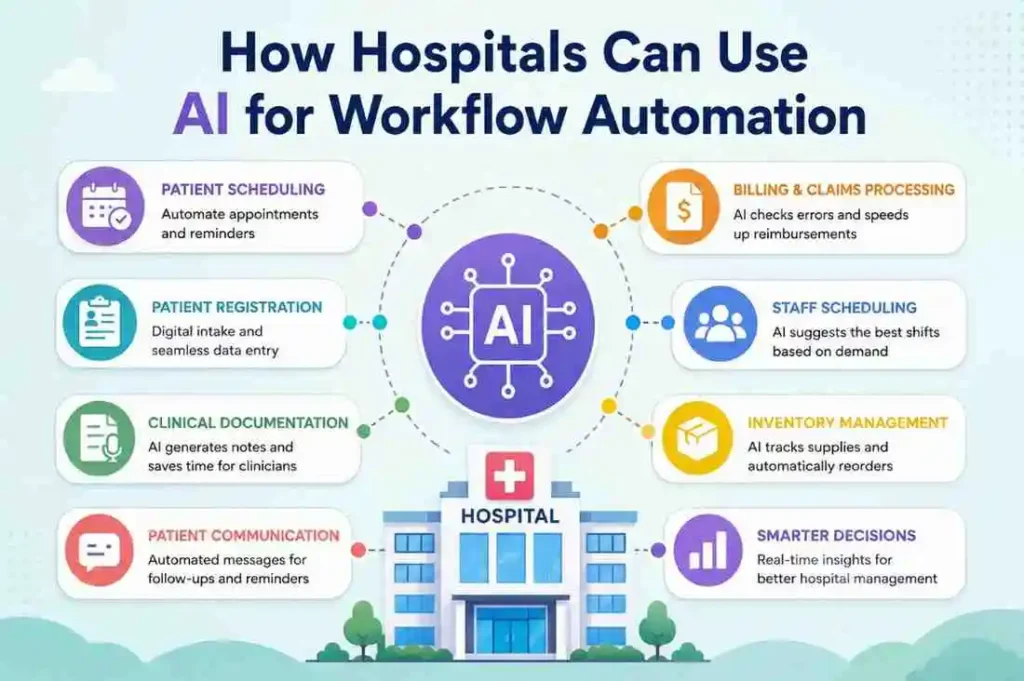
AI delivers the greatest value when applied to high-volume, clearly defined processes. Here are the core areas where hospital automation makes an immediate and measurable difference:
- Patient Scheduling
AI automatically books, confirms, and reschedules appointments while sending smart reminders that reduce no-show rates.
- Patient Registration and Intake
Digital intake forms capture patient information before arrival and push it directly into the EHR, eliminating manual data entry at the front desk.
- Clinical Documentation
AI transcription tools listen during physician-patient consultations and generate structured clinical notes in real time, saving clinicians several hours every day.
- Billing and Claims Processing
AI reviews medical claims for coding errors before submission, reducing rejections and accelerating reimbursement cycles.
- Patient Communication
Automated messaging handles discharge instructions, medication reminders, and post-visit follow-ups without requiring any staff involvement.
- Staff Scheduling
AI analyses historical patient demand patterns and recommends optimal shift assignments, reducing overtime and improving coverage during peak periods.
- Inventory Management
AI monitors supply levels continuously and triggers automatic reorder requests before critical items run out.
How AI for Workflow Automation Improves Hospital Efficiency
The impact of intelligent healthcare automation touches every layer of hospital operations.
| Benefit | How AI Helps | Impact on Hospitals |
| Reduced Administrative Burden | Automates scheduling, documentation, and billing tasks | Staff focus more on patients and less on paperwork |
| Lower Operational Costs | Minimises manual effort in repetitive processes | Significant savings in overhead and error-related rework |
| Faster Patient Access | Automated scheduling and intelligent triage | Shorter wait times and higher patient satisfaction |
| Improved Billing Accuracy | AI flags errors and validates claims pre-submission | Fewer rejections and faster revenue cycles |
| Smarter Staff Allocation | Demand-based shift recommendations | Reduced burnout, lower overtime, better care coverage |
| Enhanced Patient Communication | Personalised, automated outreach throughout the care journey | Higher engagement and better care adherence |
Real-World Applications of AI in Hospital Workflows
Understanding the theory is useful. Seeing how it works in practice is even better.
AI Chatbots
are deployed on hospital websites and patient portals to answer common queries, guide patients through services, collect pre-visit information, and direct urgent cases to the right care pathways all without staff involvement, around the clock.
Intelligent Triage Tools
assess patient-reported symptoms in emergency and urgent care settings and prioritise cases based on clinical urgency. This reduces crowding and ensures the most critical patients receive attention first.
Predictive Staffing Platforms
use historical patient data and real-time census figures to forecast demand and recommend staffing levels by unit. Hospitals using these tools consistently report fewer overtime incidents and better nurse-to-patient ratios.
AI-Powered Operational Analytics
give hospital leadership a real-time view of performance across departments from bed occupancy and procedure throughput to billing cycle times and patient satisfaction scores turning operational data into decisions.
Challenges to Plan For
Adopting AI in healthcare comes with real considerations that every organisation must address thoughtfully.
Data Security and Compliance is the top priority. Any AI system handling patient data must comply with applicable regulations such as HIPAA in the US or GDPR in Europe and incorporate strong encryption, access controls, and full audit logging.
Legacy System Integration is a common challenge. Many hospitals run older platforms that were not designed to connect with modern AI tools. Choosing solutions built around standard healthcare interoperability protocols like HL7 FHIR significantly reduces this friction.
Staff Adoption is often underestimated. Early involvement of frontline staff, clear communication about how automation supports rather than replaces their roles, and role-specific training make a meaningful difference in how quickly and successfully new tools are embraced.
Best Practices for Successful Implementation
- Start with high-volume, low-risk processes like scheduling and billing before expanding to more complex workflows.
- Define measurable success criteria upfront so you can evaluate results clearly.
- Choose purpose-built healthcare technology rather than generic automation tools that lack clinical and compliance context.
- Pilot in one department before rolling out organisation-wide.
- Always maintain human oversight build clear escalation paths for cases that fall outside the automated workflow.
The Future of AI for Workflow Automation in Healthcare
Gartner predicts that AI-augmented automation will become foundational operating infrastructure for healthcare organisations not an optional enhancement, but a core requirement for efficient, competitive care delivery.
Ambient documentation, where AI generates complete clinical notes from natural conversation, is already gaining traction. Predictive clinical analytics, highly personalised patient communication, and AI-driven supply chain optimisation are all emerging rapidly.
Hospitals investing in healthcare digital transformation today are building the operational foundation that will define care delivery for years to come.
Why Choose Appbirds Technologies
At Appbirds Technologies, we build healthcare technology that fits the way your organisation actually works, not the other way around.
Our services include hospital management systems, AI-powered workflow automation, mobile healthcare applications, EHR and third-party system integrations, and scalable digital healthcare infrastructure all designed with compliance, security, and operational complexity in mind.
We work as a genuine partner to healthcare organisations, understanding your workflows before recommending solutions, and supporting you through implementation and beyond.
If you are ready to explore what AI for workflow automation can do for your hospital, we would love to help.
Visit Appbirds Technologies to learn more about our healthcare solutions. Contact our team to start a conversation tailored to your needs.
Frequently Asked Questions
What is AI for workflow automation in healthcare?
It is the use of artificial intelligence to automatically manage repetitive administrative and clinical tasks such as scheduling, billing, documentation, and patient communication so healthcare staff can focus on higher-value, patient-facing work.
How can hospitals benefit from AI workflow automation?
Hospitals benefit through lower administrative costs, faster billing and claims cycles, reduced staff burnout, shorter patient wait times, fewer no-shows, and measurably improved patient satisfaction scores.
Is AI workflow automation secure for hospitals?
Yes, when implemented with proper healthcare-grade security. Solutions should comply with HIPAA or GDPR, include data encryption and role-based access controls, and maintain comprehensive audit logs for every transaction.
What hospital processes can be automated using AI?
Patient scheduling, registration, clinical documentation, medical coding, billing, insurance claims, patient follow-up messaging, staff shift scheduling, and inventory management are all strong candidates for AI-driven automation.
Conclusion
The operational pressures hospitals face today are real and growing. Administrative tasks are consuming resources that should be going toward patient care. Staff are burning out. Patients want better experiences.
AI for workflow automation addresses all of this in a practical, proven way. It removes unnecessary friction, reduces errors, and creates a better working environment for staff and a better care experience for patients.
The technology is ready. The results are well-documented. The next step is choosing the right partner to help you implement it well.
Appbirds Technologies brings the expertise, healthcare-specific knowledge, and commitment to deliver automation solutions that work in the real world. Contact us today and let’s build something that makes a genuine difference for your organisation.

1 thought on “How Hospitals Can Use AI for Workflow Automation”